
Monopoly Live casino in the UK: how it works
 Available in GB
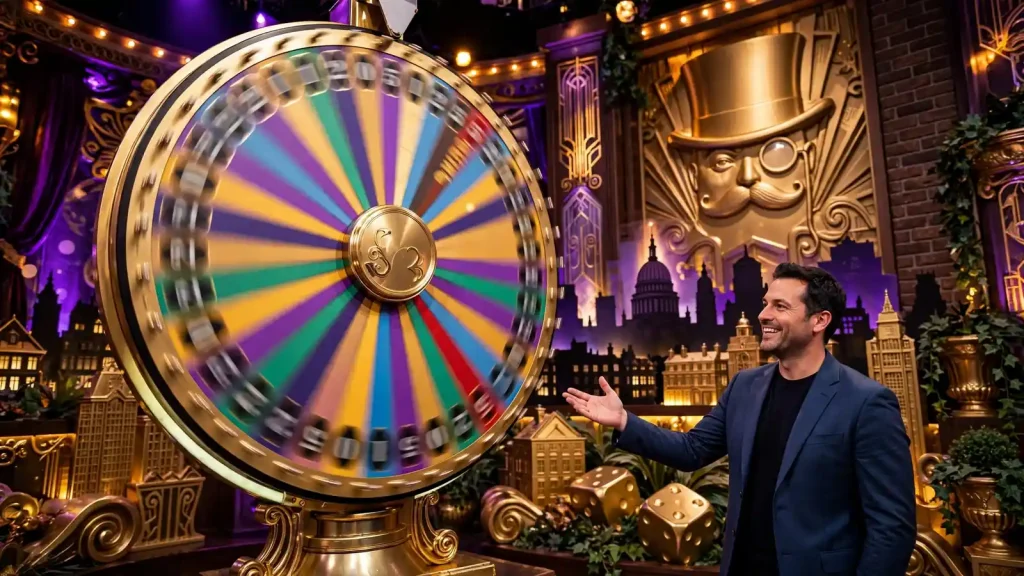
The game uses a live wheel and a themed bonus feature, not familiar board-game rules or a conventional slot format.
What Monopoly Live Is—and What It Isn’t
Monopoly Live is a live casino game built around a televised game-show presentation. A host, a physical wheel and a Monopoly-themed bonus feature give it a different feel from a conventional table game. You make a wager on the available outcomes, then watch the live round play out. The board-game look is part of the presentation; it does not mean you are playing the familiar family game with its usual rules.
That distinction caught me out at first. I saw the Monopoly name and expected a board-game experience. What you get instead is a casino game using the theme: the wheel determines the main result, while certain outcomes can lead to a bonus feature presented through a Monopoly-style board. The host and studio add theatre, but they do not change the basic point that your wager is exposed to chance.
It is also not an online slot. A slot typically presents its result through reels or symbols generated for a spin. Monopoly Live centres on a live wheel and a host-led round, with a themed bonus element available as part of the game. The screen may be busy and colourful, but that alone does not make it a slot. Nor should you assume that rules applying to online slots automatically apply to this game: the formats are different, and their rules and limits are not interchangeable.
The same goes for roulette. Both games can involve wagering on outcomes associated with a wheel, which makes the comparison understandable, but Monopoly Live is not simply roulette with a different graphic. Its wheel layout, outcome options and bonus feature belong to its own game rules. Roulette has its own table and betting structure. If you move between the two, take the time to read the rules shown for the game you have actually opened rather than carrying over assumptions from the last table.
Online Casino Without ID in the UK: What to Expect
Blackjack is further removed. There, players make decisions during a hand against the dealer, with the aim of getting a hand closer to the target than the dealer without going over it. Monopoly Live does not ask you to play a hand or make that kind of decision. You choose what to wager on before the round resolves, then the wheel and any qualifying bonus feature determine what happens. The host may make the session feel interactive, but you are not playing against the host.
The “live” part means you see a streamed presentation with a real host operating the round, rather than just tapping through a solitary animated game. It can make the experience feel more like watching a studio show than looking at a standard casino interface. Still, the stream is presentation, not a promise that you can influence the result. Chat, graphics and commentary do not turn a chance-based outcome into a skill contest.
Monopoly Live can also be confusing because the main wheel and the bonus round are presented together. They are related parts of one game, but the bonus feature is not the same thing as the board game itself. If you are unfamiliar with the format, the useful starting point is the paytable and game rules: identify what each wager covers, what triggers any feature and how a result is settled. Don’t rely on the Monopoly branding to fill in those details. It is a theme, not a rulebook.
That matters when you compare it with other games. A roulette player might recognise the broad idea of wagering on a wheel, while a slot player might recognise the appeal of a bonus round. Neither resemblance makes the rules equivalent. The details that matter are specific to Monopoly Live, and the interface should explain them before you play. A familiar name can make a new format look easier to read than it is.
The game’s show format can be entertaining, but entertainment and outcome are separate things. A dramatic pause before the wheel stops is still a dramatic pause; it does not tell you what will happen. The themed board can make a bonus round feel more substantial, but visual excitement is not evidence that a particular wager is more likely to pay. I’ve learned not to mistake a lively screen for useful information.
Attention: Do not mistake the Monopoly branding for a rulebook; the game is a themed casino experience, not the familiar family board game.
So, when you see Monopoly Live described as a casino game, think of a host-led wheel game with a Monopoly-themed bonus feature—not a slot, a roulette table, blackjack or the board game from home. Each comparison explains one small part of the presentation, then breaks down if you treat it as a substitute. Read the game’s own rules, keep the format in perspective, and only gamble what you can afford to lose. No shortcuts.
Playing Monopoly Live Online in Britain
Finding Monopoly Live in an online casino lobby is only the first part of the picture. The game is being offered remotely: you use a website or app to access a casino service rather than travelling to a venue. For someone in Great Britain, the important point is who is providing that service and whether the operator is authorised to serve customers here.
The Gambling Commission requires remote operators serving consumers in Great Britain to hold the relevant licence. That obligation applies even if the operator or the equipment it uses is based elsewhere. A casino cannot avoid the rule simply by hosting its website or game equipment outside the country. If it is selling remote gambling to people in Great Britain, its licence position matters.
That is a more useful starting point than the wording around a game in a lobby. A page may describe an online casino with Monopoly Live, but the presence of a title does not establish that the operator is entitled to offer gambling to British customers. I separate those two questions: is the game available through the service, and is the service permitted to operate in this market? One does not answer the other.
Casino Games: Slots, Live Tables and Game Guides
The same applies when a site promotes itself as the best online casino with Monopoly Live. “Best” is a sales label, not proof of authorisation or a guarantee about the experience. I have learned not to let a prominent game tile do the thinking for me. The offer may catch your eye; it should not be the whole basis for deciding whether to use the site.
Access can also depend on the operator’s own arrangements. A game might appear in a lobby, be reachable only after signing in, or not be presented to every visitor in the same way. Those details are about that particular service, not a promise that every remote casino will carry the same games or make them available under identical conditions. If you are trying to play Monopoly Live online, check that the game is actually available to you before treating a promotional mention as a live offer.
For people in Great Britain, online gambling is legal from the age of eighteen when it is offered by an operator holding a Gambling Commission licence. Operators must verify a customer’s age before allowing a deposit. That makes account access more than a matter of entering a username and password: the operator has responsibilities before money can be placed into a gambling account.
Licensing Risk
Only use operators holding a Gambling Commission licence; being able to open a website does not mean the operator is authorised to serve customers in Great Britain.
I would not treat being able to open a page as evidence that all those conditions have been met. A site can be visible from your device without that alone settling whether its operator is properly licensed for customers here. Nor does the game’s familiar branding establish the operator’s status. The licence obligation belongs to the remote gambling operator providing the service.
There is a practical difference between browsing and gambling. Reading a game description or viewing a lobby does not require you to deposit. If you move towards real-money play, pause long enough to understand which operator is behind the page and whether it is licensed to serve Great Britain. The separate checks involved in verifying a particular licence are worth doing before you sign up; a familiar game name is no substitute.
I also keep the money side plain. Monopoly Live is still gambling when played online, however polished the presentation may be. Only gamble with money you can afford to lose. That is not a clever way to improve the odds; it is a boundary worth keeping before the game, the lobby or the marketing gets your attention.
Checking a Casino Before You Sign Up
A table that looks polished tells you nothing about whether the company behind it is authorised to take your money. When I’m checking a casino that says it offers Monopoly Live, I start with the regulator, not the game page or a “trusted” badge. The UK Gambling Commission oversees gambling in the UK, including online casinos, and it is the sole regulator for commercial gambling in Great Britain.
Online Bingo in the UK: Rooms, Slots and Offers
The important point is that the licence obligation follows the service offered to British customers, not the location of a studio or other key equipment. A remote operator serving people in Great Britain needs the relevant Gambling Commission authorisation even if its equipment is elsewhere. So a claim that a casino is based abroad does not, by itself, answer whether it is licensed to offer gambling here.
Business and personal licences
There are two kinds of licence that are easy to muddle. An operating licence is issued to a business, while a personal licence applies to an individual working in gambling operations. They do different jobs. For a player assessing a casino, the company’s operating licence is the central question: a named person’s licence is not a substitute for the business being authorised.
I used to treat a licence logo as if it settled the matter. It doesn’t. A logo on a page is a claim made by the operator; the public Gambling Commission register is where you can check the licence number itself. Before depositing, look up that number and make sure the registered business corresponds to the casino you intend to use. If the company name or domain does not line up, pause rather than assuming that similar branding proves a connection.
Do
- Check the licence number on the public Gambling Commission register
- Ensure the registered business matches the casino domain
Don’t
- Rely on a licence logo displayed on the page
- Assume a company is licensed because it is based abroad
This is a more useful test than collecting recommendations for the best Monopoly Live casinos. A review can help you find a site that advertises the game, but it cannot replace checking the operator’s status independently. Nor does seeing a familiar live table establish that the website carrying it is properly licensed. The operator is the part you need to verify.
Be careful with the wording on a site, too. A business may present a brand name, a company name and a web address that look different. Read the licence details alongside those identifiers, rather than checking only whether a name appears somewhere in a register. If you cannot make a clear match, do not treat uncertainty as proof that everything is in order. I’d rather lose the convenience of signing up than guess.
That check is about authorisation, not a promise that the casino is a good fit or that a particular game will suit you. A licence does not make gambling risk-free, and it cannot turn a game into a way to earn money. “Best” is often a sales word; the useful question is whether the operator is licensed for the service it is offering to British customers.
I also separate the operator’s business licence from the personal licences held by people working in the industry. Both exist within the Commission’s system, but they are not interchangeable credentials. If a site points to an individual’s status while leaving the company’s authorisation unclear, that does not answer the question that matters before you open an account.
Mines Casino Game UK: Demo, Play and Licensing
Once the licence check is clear, there are still account conditions and personal safeguards to consider; authorisation is only the first screen, not a recommendation. And whatever you decide, only gamble with money you can afford to lose. No clever Monopoly Live tip changes that.
Getting Started at the Table
Before I sit down at a real-money table, I try to separate the game from the decision to spend. The animated board and live host can make a session feel more like a show than gambling. It is still gambling: money can go, and a lively presentation does not make the outcome safer or more predictable.
Start with the account, not the table. A UK-licensed operator must verify your age before allowing you to deposit. New customers must also be prompted to set a financial limit before their first deposit, with account-level controls available afterwards. Take that prompt seriously. Set a figure that fits your own finances, then check where you can review or change the controls. I have brushed past account settings before because I wanted to get to the game. That is the wrong order.
Use a payment method you understand and can afford. UK-licensed casinos cannot accept credit cards for gambling, including credit-card funds routed through a money service business. They also cannot accept wallet payments where the wallet lets you use credit-card funds for gambling. If a payment option is unclear, pause and read the operator’s explanation rather than assuming it works like an ordinary card payment.
Account and Table Setup
- Verify your age through the operator
- Set a financial limit before the first deposit
- Check available stake options and table rules
- Confirm your payment method does not use credit cards
Once logged in, open the table and check the information shown before placing a wager. Look at the available stake options, any displayed table rules and the controls for confirming or cancelling an action. Do not assume that limits or rules from a slot, roulette or blackjack table carry over to Monopoly Live. They are different games, and the terms on the table you are actually using are what matter.
I also decide the session boundary before I start. Choose an amount you can afford to lose, and do not treat a win as money you are owed or a loss as something to recover. If you find yourself raising your stake because you are annoyed, chasing a previous result or losing track of time, step away. A preset account limit can help put a firm edge around spending, but it cannot make a session profitable.
Check that the account offers the controls you may need, including deposit limits and self-exclusion. UK-licensed casinos must provide responsible-gambling tools, and you should be able to find them without digging through a maze of menus. If you need support, services such as GamCare and BeGambleAware can provide help; Gamblers Anonymous is another support option. Asking for help is not a confession of failure. It is a practical step.
If you are using a casino app, apply the same checks there as on the website. An app does not change the game’s risks or the safeguards attached to your account. Keep access to your account secure, and do not let a quick notification or a spare moment decide when you play.
Best Keno Online Casinos in the UK: Licence Checks
For me, the useful routine is plain: set the limit, check the table, make a deliberate wager, then stop when the boundary is reached. Only gamble what you can afford to lose. No clever workaround.
Results, Randomness and What You Can Actually Check
A Monopoly Live result can tell you what was recorded for a completed round. It cannot, by itself, tell you what the next round will produce. That distinction sounds obvious until you have watched a run of similar outcomes and started treating it as a clue. I have done that. A pattern can feel persuasive when you are staring at it; feeling persuaded is not the same as having evidence that it predicts anything.
If you look at a results page or tracker, start with the record itself. Is it showing completed outcomes, and is it clear which game or session they belong to? Does the page explain how entries are collected, or does it simply present a string of symbols and invite you to draw conclusions? A display can be useful for reviewing what you have already seen. Its existence does not make it an official record, and a confident-looking chart does not establish that its data are complete or independently checked.
Be wary of language that turns a past result into a forecast. Claims that a particular outcome is “due”, that a streak is about to end, or that a recent run makes another result more likely need evidence beyond the run itself. A tracker that counts previous outcomes may describe the past accurately while still saying nothing dependable about what comes next. Those are different jobs.
A results tracker shows completed outcomes from the past, but it cannot predict or influence the result of the next round.
What a result can and cannot show
A record may help you check what happened in a round you watched, compare your recollection with the displayed outcome, or keep notes about your own session. It can also help you notice how quickly you begin to invent a story around a sequence. That is useful self-observation. It is not a betting system.
The same caution applies to rules and bonus claims. If a page uses a result history to imply that you can exploit a pattern, look for a clear explanation of how that conclusion was reached. A bonus offer is a separate promotion, not evidence that a result is more likely to go your way. Read the offer’s terms rather than assuming the word “bonus” means a better chance or a simpler route to a return.
I used to mistake a tidy table of past outcomes for insight. The table looked objective, so I gave my interpretation of it more weight than it deserved. The uncomfortable part is that a record can be accurate and still be irrelevant to the next round. Neat presentation is not prediction.
If you keep a tracker yourself, make it a record, not a signal. Note what you observed without changing your wagers because a sequence seems unusual. If you cannot tell where a tracker gets its information or how it handles missing entries, treat its figures cautiously. And if its main pitch is that it has cracked a pattern, ask what would prove that claim wrong. If there is no answer, you are being sold confidence, not certainty.
Online Casino Tournaments UK: Rules and Offers
Results can help you review a session, but they cannot remove chance or make a future outcome safe to call. Set your own limit before you play, and only gamble what you can afford to lose. My old mistake was believing that one more look at the history would make the next wager feel informed. Sometimes it only made me more determined.
Live Casino Games Around the Monopoly Live Table
A live casino is not one uniform kind of game. The label covers familiar table formats as well as more theatrical, game-show-style titles, and that difference matters when you compare what a session feels like. Monopoly Live sits in the latter territory: it takes its cues from a show, rather than asking you to approach it like a conventional card table.
That wider setting helps explain why the game can feel at home beside blackjack or roulette without working like either. A casino lobby may group them under the same live-casino heading, but the label describes the broad format, not shared rules or a shared way of making decisions. I used to assume neighbouring tiles meant neighbouring mechanics. They don’t.
There is a long history of established casino games appearing in online live offerings. Grosvenor first introduced its live casino games in 2013, with card and casino options including blackjack, Texas Hold’em and roulette. That early line-up is a useful point of comparison: live casino did not begin and end with a single game style. It could bring recognisable table formats online, while the wider category has room for more entertainment-led designs too.
Card Games
Involve following a hand and specific rules, such as blackjack or Texas Hold’em.
Wheel Games
Centre on a wheel and a result, such as roulette.
Game-Show Titles
Put more emphasis on presentation and special features, such as Monopoly Live.
If you are looking at Monopoly Live as part of that landscape, the practical question is not simply whether it is “live”. Ask what kind of experience you want. A card game may involve following a hand and its rules; roulette centres on a wheel and a result; a game-show title may put more emphasis on presentation and special features. Those are different ways to spend a session, not interchangeable versions of one table.
That distinction also helps when reading a Monopoly Live game review. A review that only says the game looks lively tells you little about whether you will enjoy its pace or format. I would look for an explanation of what happens during a round, what the interface asks you to do, and how the game differs from the card and wheel games around it. “Exciting” is a sales word. The useful detail is what you actually see and choose.
The same goes for wondering how Monopoly Live works beside other live-casino games. Its place in the lobby does not make it a substitute for roulette, blackjack or Texas Hold’em, and their rules should not be carried across by assumption. I have made that mistake with games that looked familiar at a glance. Bad shortcut.
A broader live-casino menu can make it easier to find a format that suits your attention and preferences, but variety is not a reason to keep switching when a session stops feeling comfortable. Set your own boundaries, and only gamble what you can afford to lose.
Our top casino picks for the UK
- ChanzeBonus: Slots Welcome Bonus #1 200% up to €500 · Payout speed: 1-3 business days
- AmunbetBonus: Join now and get 450% up to 2,700 GBP + 450 FS · Payout speed: 1-3 business days
- x3betBonus: Welcome Pack 100% Up to £1.000 + 200 Free Spins · Payout speed: 1-3 business days
- Revery PlayBonus: 100% up to€1,000+ 100 FS · Payout speed: 1-3 business days
- NightLuckBonus: Welcome Pack + 805% Up To 6400€ + 280 FS · Payout speed: 1-3 business days
- BritsinoBonus: Welcome Package – Get your £2,200 + 2,000 FS · Payout speed: 1-3 business days
Stats and Strategy Without the False Promise
A tracker can make a run of results look like a pattern. I’ve stared at enough tables of past outcomes to know how easy it is to start seeing one: a feature has not appeared for a while, so surely it is “due”. That is a feeling, not a reliable prediction. A history page can help you review what has already happened; it cannot tell you what the next spin or feature will bring.
The same goes for a strategy built around statistics. Before trusting a chart, check what it counts, how it was collected and whether it covers the same version of the game you are playing. A partial record may leave out sessions or outcomes, while a percentage without a clear method is hard to interpret. Even a complete and accurately presented history remains a record of past play, not a promise about future results.
“Hot” and “cold” are persuasive labels, but they can turn ordinary variation into a betting plan. Increasing your wager because a feature seems overdue does not make it more likely to appear. Nor does a streak prove that the game has changed. I’ve made that mistake myself: the numbers looked like a clue, and I treated them as one. They weren’t.
Attention: Do not apply online slot stake caps or statistics to Monopoly Live; it is a live table game with its own rules and wager options.
Be wary of strategy claims that show a winning sequence but leave out losing sessions, the size of each wager or the conditions under which the figures were gathered. Ask what the claim actually measures. Does it describe a past sample, or does it pretend to forecast your next session? Those are different things. A confident chart can still be a poor basis for a money decision.
Limits need the same care. One specialist review describes Great Britain’s online slot stake caps as £5 per game cycle for players aged 25 and over, and £2 for those aged 18 to 24. Treat that as a statement about online slots, not a rule that can be carried across every casino game. The same review distinguishes roulette and blackjack from those slot limits; a live table game has its own rules and wager options. Monopoly Live should not be treated as an online slot simply because it includes a wheel and game-show features.
That distinction matters when someone uses slot statistics or stake rules to make a claim about a live game. Check that the figures refer to the same product and type of play, rather than relying on a familiar-sounding number. A tracker’s labels do not change the game’s mechanics.
The most useful strategy may be deciding what you can afford to lose before you start, then sticking to that boundary rather than chasing a pattern. Don’t wager money you need for other things. No chart can remove the risk.
What to Look for on a Casino Site
When a site says it has Monopoly Live, I start with the page itself, not the banner. Can I find the game in its lobby, and do the rules and table information belong to the game I’m about to open? A familiar title in an advert is not proof that the same game is available after you sign in.
Before depositing, check the operator’s licence number against the UK Gambling Commission’s public register. Make sure the registered business and website details match the site you are using; a logo in the footer is not the check. A casino serving players in Great Britain needs the relevant Commission licence. I used to treat a polished design as reassurance. It isn’t.
Then look at what the account asks you to do. Operators must verify your age before allowing a deposit, and new customers must be prompted to set a financial limit before their first deposit. Find the account controls as well: limits should remain accessible, rather than disappearing after setup. If you have to hunt through vague menus to find them, take that as useful information about the site.
Check the payment options, too. UK-licensed casinos cannot accept credit cards for gambling, including through a wallet that lets you use credit-card funds. The site should also make its complaints process and access to an approved Alternative Dispute Resolution service clear. Those details matter more than a loud “trusted” badge.
I look for self-exclusion and other responsible-gambling tools before play, not after a session has gone sideways. If the site makes basic account safeguards hard to locate, I don’t rush to hand over payment details. And however convincing the presentation feels, only wager what you can afford to lose.
Final Safety Check
- Verify the operator’s licence via the official UK Gambling Commission register
- Use mandatory account controls and financial limits before playing
- Avoid using credit cards or credit-card funded wallets
- Only gamble with money you can afford to lose
Trying the Demo Before You Deposit
A Monopoly Live demo can be useful for one modest reason: it lets you look around before real money is involved. I use a free version to get a feel for the screen, find the controls and read the information shown at the table. That is practical familiarisation, not a rehearsal that tells you what a paid session will do.
Take a moment to see where the wager options sit and how the interface shows the game’s rules or round information. If the presentation feels confusing, that is worth knowing before you decide whether you want to play at all. You can also check whether the video and sound work comfortably on your device. Small things, but better noticed without money in play.
The word “demo” can sound like a preview of the real thing. It is only a preview of the interface and experience on offer. Free play does not prove that real-money results will follow the same pattern, nor can a short trial establish what outcomes you should expect. A run that looks favourable is not a signal. Neither is a poor one.
A Monopoly Live casino demo in the UK may not be available in the same form at every site, so check what the version actually lets you do rather than assuming it matches a paid table in every detail. Treat any displayed play as a chance to understand the controls, not a strategy test.
I’ve made the mistake of letting a smooth-looking trial make paid play feel more predictable than it was. It wasn’t. If you move on to real-money gambling, only wager what you can afford to lose. A demo can help you decide whether the game’s interface suits you; it cannot make the financial risk smaller.
A Candid Review: What a Free Version Can—and Can’t—Tell You
A free version of Monopoly Live can be useful, but only if you treat it as a preview rather than a rehearsal for guaranteed results. I’d use it to see whether the screen is readable, whether I can follow what is happening and whether the pace suits me. Those are practical things to learn before deciding whether I even enjoy the format.
That is the useful part. The demo can show you the interface as it is presented there; it cannot tell you what a real-money session will feel like once your own balance is involved. I’ve made the mistake of thinking that feeling comfortable with a game meant I was ready to wager. It didn’t. Familiarity is not control.
A no-stakes session also cannot establish what will happen in a paid session, or whether a particular run of results is likely to continue. If the free version seems generous, that is not evidence that paid play will behave the same way. Nor does an enjoyable trial make the game a sensible fit for your finances. Different stakes can change how every result lands emotionally. That bit is real.
So, in my review, the free version gets credit for helping you judge the presentation and your own interest—not for predicting returns. It is a narrow test, and that is fine. A narrow test is better than mistaking an easy preview for proof.
If you move from trying it for free to wagering real money, set a limit you can afford to lose and stick to it. Don’t use a demo as a reason to deposit, and don’t chase losses because the paid version feels different from the preview. If you find yourself treating free play as a promise of what comes next, step back. The screen can familiarise you; it cannot make the decision for you.
Are online casino games licensed and regulated?
Yes. The UK Gambling Commission regulates online gambling offered to consumers in Great Britain, and remote operators serving them must hold the relevant licence.
What are the online slot stake limits in Great Britain?
The limit is £5 per game cycle for adults aged 25 and over, and £2 for adults aged 18 to 24. These limits do not apply to roulette or blackjack.
Is LuckyPays licensed by the UK Gambling Commission?
The Commission’s public register dated 26 September 2026 does not show an entry for LuckyPays or its stated domain, luckypays.io.