
Crazy Time Live Casino Game Show in the UK
 Available in GB
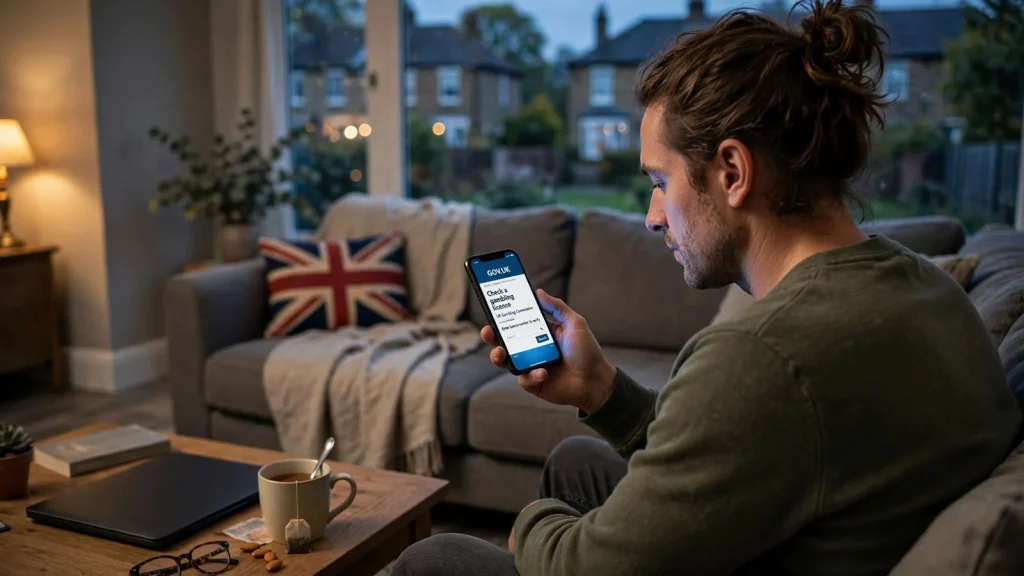
A guide to operator licensing, finding the game, understanding stake labels and exploring demos, bonuses and live casino options.
Check the Licence Before You Play
A casino can put “UK” in its branding, display a licence badge, or say it is regulated. None of that settles the question. Before I trust a site with money, I check the UK Gambling Commission’s public register itself. The Commission is the regulator for commercial gambling in Great Britain, including online casinos, and remote operators serving customers there need the relevant licence. The operator’s location does not change that requirement.
Start with the operator, not the game. Crazy Time may appear on a casino’s site, but the game’s presence does not establish that the casino is authorised to offer gambling to people in Great Britain. The relevant check is whether the business running the casino holds an appropriate operating licence. The Commission issues operating licences to businesses and personal licences to individuals working in relevant roles; seeing a person’s name or a provider mentioned is not a substitute for checking the operator.
Use the register rather than following a badge link and assuming it proves everything. Search for the casino’s trading name and, where available, the legal business name. Then compare what you find with the operator details and website address shown by the casino. A similar name is not enough. A licence belonging to a different company, or a listing that does not correspond to the site you are using, does not show that this particular casino is covered.
The domain matters. A business may use a recognisable brand across more than one website, and a copied logo or familiar name can make an unrelated site look convincing. Check whether the listed business and domain match the casino in front of you. If they do not line up, pause and resolve the discrepancy before registering or depositing. I have been too quick to trust a polished page; it is an easy mistake to make when everything looks familiar.
Live Dream Catcher Casino UK: Licence and Site Checks
The register is more useful than a claim on the casino’s own pages because it is maintained by the regulator. Still, take care with what a search result does and does not establish. A result for a company with a similar name is not confirmation that the brand you are considering is operated by that company. Likewise, a company’s licence does not mean every site using its name is automatically covered. Match the details, rather than ticking a box because one word looks right.
A specialist review describing a check of the public register dated 26 September 2026 reported no LuckyPays entry under that brand or its stated domain, including luckypays.io. Treat that as a reason to check the register directly, not as a substitute for doing so: register information can change, and the important question is what the regulator’s record shows for the operator and website you intend to use. A brand’s own assurance cannot fill a gap between its claim and the regulator’s listing.
If you cannot establish a clear match, do not rely on customer-service reassurance alone. Ask the operator for the legal business name and licence details, then verify those independently on the Commission’s register. If the response is vague, points you back to a badge, or gives details that do not match the register, I would leave it there. No game is worth guessing who is responsible for the site.
This check is about the casino operator, not whether a particular game is fair, enjoyable, or right for you. A valid operator licence is a basic safeguard, not a promise that you will win or that you should play. Keep that distinction in mind when a site uses words such as “trusted”: the word is marketing; the register is something you can inspect.
I also try not to turn a licence check into a one-off ritual. Revisit the register if the operator changes its name, the website address changes, or the casino’s account pages identify a different business from the one you checked. Keep the exact domain in view. A small mismatch can matter.
If anything remains unclear, stop before sending money and check the regulator’s information directly. I would rather lose a few minutes confirming the operator than find out later that I trusted the wrong name. And whatever you choose, only gamble what you can afford to lose.
Licence Verification
Do not rely on branding or badges; check the UK Gambling Commission’s public register to ensure the operator holds a valid licence.
Finding Crazy Time in an Online Casino
Crazy Time can be easy to miss if you browse a casino lobby without a plan. I’d start with the casino’s search box and enter the game’s name, then look through categories such as live casino or game shows if the search does not bring it up. Lobby labels differ, and a category can group together games that have little in common beyond their presentation. Treat it as a way to narrow the menu, not as a guarantee that the game is available.
When it does appear, check the game title and the information shown on its launch page before opening it. Casino menus can include promotional tiles and related suggestions alongside games; a colourful banner is not the same thing as access to the actual game. I’ve wasted time clicking through those before. Read what is on the game tile, and follow the route that opens the game itself rather than assuming every Crazy Time reference leads to it.
Before opening the game
A UK casino should verify your age before it lets you deposit into a gambling account. You must be at least 18 to gamble online at a properly licensed UK site. If you are asked to complete age checks, do that through the operator’s account process; do not try to work around it by depositing first or using another person’s details. The check is part of getting an account ready for real-money gambling, not a hurdle to ignore.
Deal or No Deal Casino UK: Game and Safety Checks
I also check how the game is being presented. Is the page clearly for Crazy Time, or have I landed on an offer page that mentions it without making clear whether the game is included? That distinction matters when a promotion is involved, but the game’s presence in a lobby does not mean you need to accept an offer. You can look for the game without opting into a promotion.
Payment is another practical check before you fund an account. Remote gambling operators cannot accept credit-card payments for gambling. That restriction also covers credit-card funds routed through a money service business, and operators cannot accept wallet payments where the wallet allows credit-card funds to be used for gambling. A payment method appearing in an account menu does not automatically mean every way of funding it is permitted for gambling. If you are unsure how a wallet is funded, check its terms and the casino’s payment information before using it.
Don’t confuse a payment option with a recommendation to spend. I’ve found it helpful to decide what I can afford to lose before I open a real-money game, rather than making that decision while the lobby and its prompts are in front of me. Keep the amount within that boundary. If you cannot do that comfortably, leave the game closed.
A sensible route through the lobby
For an online casino with Crazy Time, the simplest route is usually to sign in only after you have found the game page and understood what the next step requires. If the lobby asks you to deposit before you can proceed, pause and read the account and payment information rather than treating the prompt as part of the game. You are choosing whether to fund an account; you do not have to do it just because a game has caught your eye.
Accessing the Game
- Find the Crazy Time game page using the search box
- Verify your age through the operator’s account process
- Confirm the payment method is not a credit card
- Decide on a loss limit before funding the account
I would not assume that every casino serving UK players lists the same games, uses the same menu, or presents access in the same way. Search within the casino you are actually considering, and check that the result is the game you intended to open. If the title is absent, an advert or a third-party page cannot make it available in that casino.
Keep the steps separate: find the game, understand the account and payment requirements, then decide whether to play. No rushed deposits. And only gamble what you can afford to lose.
Slot Stake Limits—and Why the Label Matters
A stake limit can sound like a simple rule until you have to work out which kind of game it covers. I used to see a maximum stake mentioned and assume it applied across the whole casino lobby. That is not a safe assumption: the limits described for online slots in Great Britain do not automatically cover every game with a wheel, a dealer or a live presenter.
A specialist review reports that the online slot cap is £5 for each game cycle for players aged 25 or over, and £2 for those aged 18 to 24. Those figures are specifically about slots and the amount staked in a game cycle. They are not a general casino-wide ceiling. The review also distinguishes roulette and blackjack: the slot limits it describes do not apply to those games.
Classic Slots Online in the UK: How They Work
That distinction matters when you are looking at Crazy Time. It is presented as a live game show, but the appearance of a spinning wheel does not, by itself, tell you how the game is legally classified. Nor does the slot-limit information settle whether a particular live game falls under the rules for slots. I would not infer that from the game’s name, its screen layout or the fact that it has bonus rounds. Different labels can refer to different products and rules. Check the game information and the operator’s explanation rather than treating a slot stake cap as an answer about Crazy Time.
The practical point is narrow but useful: the figures above concern online slots, while roulette and blackjack sit outside those particular limits. If you are comparing the amount you can wager across games, first establish what kind of game you are opening. A limit shown in a slot’s information may not tell you what applies to a live table or a game show. Conversely, seeing a live presenter does not prove that every stake rule is irrelevant. Classification is the hinge.
I learned to stop reading a casino lobby as if its categories were interchangeable. “Live” tells you something about how a game is presented; “slot” points to a different type of game. Neither word is a substitute for checking the rules attached to the actual product. If an explanation is vague, do not fill the gap with a guess based on another game.
The stake figure also refers to a game cycle, not simply to a headline number on a promotional tile. That makes the game’s own information important: look for how it describes a cycle and what counts as the stake. A displayed wager can be part of a more complicated game structure, so a quick glance at a wheel or a button may not answer the question. Keep the distinction in view, especially when moving between slots and live games.
Slot Stake Limits
The online slot cap is £5 per game cycle for players 25+ and £2 for those aged 18 to 24, but these specific limits do not apply to roulette and blackjack.
This is not a way to identify the “best” casino for Crazy Time, and it does not tell you what results to expect. It is a basic check on whether a rule you have seen is relevant to the game in front of you. I have made the mistake of carrying assumptions from one part of a casino into another. It is an easy way to misunderstand the terms before you even start.
For a slot, the cited figures give a specific age-based cap per game cycle. For roulette and blackjack, they do not. For Crazy Time, do not decide its category by resemblance alone. Read the game’s stated information, keep the distinction between a slot and a live game clear, and never wager money you cannot afford to lose.
Live Casino Games Beyond the Game Show
Crazy Time sits in a broader live-casino category, where a streamed host, a real table or studio and digital betting controls share the screen. The format can make a game feel closer to a television show than a traditional table, but it is still one part of a wider selection. If you open a live-casino lobby looking for the wheel, you may also see card games and other familiar casino formats nearby.
That context matters because the game-show presentation can dominate your attention. I have found it easy to treat the bright set and host as the whole experience, then forget that the same lobby may offer quieter games with very different rhythms. Blackjack, Texas Hold’em and Roulette are common reference points for live casino play. They do not become versions of Crazy Time just because they appear under the same heading; each has its own layout and decisions.
Crash Casino Games in the UK: What to Know
Grosvenor’s history gives one example of how this part of online casinos developed. The operator first introduced its live casino games in 2013, with a selection that included Blackjack, Texas Hold’em and Roulette. That is a useful marker of live casino’s broader appeal: it has room for established card and table games as well as a more theatrical wheel-based show. It is not a claim that every casino has the same catalogue today.
When I compare a game-show table with a card table, I try to notice what kind of attention each one asks from me. The show’s pace, presenter and on-screen effects can pull your focus in several directions; a card game tends to make its own rules and table layout more prominent. Neither presentation tells you what the outcome will be, and a lively studio is not a reason to stake more. I have mistaken production value for a reason to keep watching—and, at times, keep playing. Bad signal.
If you are browsing for Crazy Time, it helps to think of it as one live option rather than the definition of a live casino. You might prefer a host-led wheel one day and a familiar table game another. The point is not that one is better, but that the surrounding selection lets you choose a format that suits your attention and your mood. A broad menu can be useful, but it can also make switching games feel effortless when you would be better off stepping away.
Do
- View the studio as presentation
- Choose formats based on mood
- Keep stakes within affordable limits
Don’t
- Mistake production value for an edge
- Assume a lively set increases chances
- Treat a studio as evidence of a win
There is no need to turn that choice into a grand strategy. Give yourself time to understand the screen you are looking at, and do not assume the game-show style makes the experience predictable. I now treat the studio as presentation, not evidence of an edge. If I play, I keep the stake within what I can afford to lose. That boundary matters more than whether the next screen is a wheel, a card table or a roulette layout.
Our top casino picks for the UK
- ChanzeBonus: Slots Welcome Bonus #1 200% up to €500 · Payout speed: 1-3 business days
- AmunbetBonus: Join now and get 450% up to 2,700 GBP + 450 FS · Payout speed: 1-3 business days
- x3betBonus: Welcome Pack 100% Up to £1.000 + 200 Free Spins · Payout speed: 1-3 business days
- Revery PlayBonus: 100% up to€1,000+ 100 FS · Payout speed: 1-3 business days
- NightLuckBonus: Welcome Pack + 805% Up To 6400€ + 280 FS · Payout speed: 1-3 business days
- BritsinoBonus: Welcome Package – Get your £2,200 + 2,000 FS · Payout speed: 1-3 business days
A Strategy That Starts with Knowing What You Can Lose
I used to think a “strategy” meant finding a pattern other people had missed. With Crazy Time, that can lead you towards trackers, charts and confident claims about what is “due”. The trouble is that a record of earlier results tells you what has already happened; it does not promise what comes next. A tracker can organise information, but it cannot turn past outcomes into a reliable forecast.
That is the point I now start from. A Crazy Time casino strategy is not a method for making the game predictable. It is a set of decisions about whether to play, what you are prepared to spend, and when you are done. Nothing flashy. More useful than it sounds.
Before opening a real-money game, I decide what amount I could lose without it affecting bills, plans or my mood the next day. That is a limit, not a target I need to use up. If losing it would make me want to deposit again, it was too much. I have made that mistake: treating an initial amount as a starting point rather than a boundary. It is an easy way to let a short session become a bigger one.
Casino Dice Games in the UK: How They Work
I also try to decide how long I intend to play before I start. When I am already watching a game, it is surprisingly easy to keep going because I feel close to a better result, or because I want to undo an earlier loss. Neither feeling is evidence that a win is coming. If I notice myself changing the plan to chase a result, I take that as a reason to stop, not a clever adjustment.
People looking for Crazy Time casino strategies may come across a tracker that presents recent outcomes in a neat pattern. Neat does not mean predictive. I would treat a tracker as a record or a visual aid, not as a signal telling me what to wager on. The same goes for casino history pages and posts that claim a particular sequence points to a likely next result. Unless a claim can actually establish what will happen next, it is not a basis for risking money.
There is a difference between reviewing how you played and trying to decode the game. After a session, I can ask whether I stuck to my spending limit, whether I kept wagering after I wanted to stop, and whether I was playing for entertainment or trying to win back losses. Those answers can help me make a better decision next time. A history of results cannot do that job for me.
I don’t assume that a “system” makes a session safer or more profitable. It may make decisions feel more controlled, but that feeling is not protection from losing. If you choose to play, wager only what you can afford to lose, and be willing to close the game when your limit or your patience is reached. That’s the whole safeguard.
Strategy and Limits
- Use a strategy to manage spending, not to predict outcomes
- Treat trackers as records, not as predictive signals
- Set a time limit to avoid chasing losses
- Only wager what you can afford to lose
What to Expect from Crazy Time in 2026
Crazy Time is presented as a live casino game show, not as a promise of a particular result. That distinction sounds obvious until a casino page wraps the game in bright graphics, upbeat language and a promotional offer. I used to treat that whole package as one thing. It isn’t: the game is one thing; the casino’s advertising around it is another.
The year in the title does not, by itself, tell you that the game has changed or that a new version is available. It may simply help people looking for the game now. If a page claims that a special 2026 edition, exclusive feature or “new” opportunity is available, look for a clear explanation of what that means rather than taking the label on trust.
The show presentation can make the experience feel different from a conventional table game. There is a host and a studio-style setting, and the casino displays it as entertainment as well as gambling. But presentation is not evidence of better chances. A lively set, confident commentary or dramatic reveal can make each round feel meaningful; none of that tells you what the next outcome will be.
That was an easy trap for me: I mistook excitement for information. It isn’t.
You may also see claims about “hot” outcomes, lucky patterns or a supposed way to spot what is coming. Treat those as claims, not guidance. A past result or a confident-sounding explanation does not establish what will happen next. Nor should a bonus attached to a Crazy Time page be confused with a feature of the game itself. Offers come from the casino, and their conditions belong to the offer.
Mines Casino Game UK: Demo, Play and Licensing
A sensible expectation is modest: you are looking at a gambling game presented in a show format. It may be entertaining, but entertainment does not make a wager safe, predictable or profitable. I would not plan around winnings or regard a promotional headline as proof that a session offers value. If you decide to play, only wager what you can afford to lose.
For a UK reader, it is worth keeping the words “live casino” in perspective too. They describe how the game is presented, not a guarantee about the experience or a recommendation of any particular casino. A polished broadcast can feel reassuring, but it does not replace checking what you are actually choosing to play and what the casino is offering separately.
I’d read the game name, the casino’s description and any promotion as separate pieces of information. If a page blurs them together, slow down. If it makes a claim about likely winnings, ask what supports it; if the answer is only excitement, treat it accordingly. The game-show style can make Crazy Time stand out, but it cannot turn uncertain outcomes into a dependable plan.
That is the frame I’d bring to Crazy Time in 2026: a distinctive presentation, a gambling decision, and no sound basis for assuming a win. The next step is not to believe the loudest claim. It is to understand what you are looking at before deciding whether to take part.
Trying Crazy Time Without Depositing
A page calling Crazy Time “free” needs a closer look. It might mean the game can be opened without adding money, or it might be referring to a promotion with conditions attached. Those are not the same thing, and a headline alone won’t tell you which applies.
Free Play Claims
Attention: A "free" label may refer to a promotion with conditions rather than actual free access; always check the casino’s terms.
Before relying on a free-play claim, check the casino’s own information. Is Crazy Time itself named, or does the offer apply to something else? Can you access the game without making a deposit, and does the page explain whether you need an account? If the details are vague, I’d treat the claim as unconfirmed rather than assume you can sit down and play for nothing.
“Free spins” can sound like a straightforward route in, but the wording can hide important limits. Check what game the spins are for and whether Crazy Time is specifically included. A casino promotion may use “spins” as a broad advertising term; that doesn’t establish that spins can be used on a live game show. Don’t count an offer as usable until its terms say so clearly.
I’ve been caught by attractive wording before: the promise looked simple, while the conditions were somewhere else. The same basic caution applies to reviews. A Crazy Time casino review can help you spot what to investigate, but a glowing description or a claim that a site is safe is not proof that a free option is available. Look for clear, current information from the operator, and don’t let a review’s confident tone do the checking for you.
If you’re considering a real-money account, the operator must verify your age before allowing a deposit. And if you do choose to wager, only use money you can afford to lose. “No deposit” should mean you are checking the terms before committing, not that you need to rush because an offer sounds too good to miss.
Chicken Road Game Casinos in the UK: What to Check
When the free-play wording doesn’t explain what is included, pause. No assumption needed.
Bonuses, Deposits and the Small Print
A Crazy Time casino bonus can look like extra balance, but I treat the headline as the start of the reading, not the conclusion. A welcome or deposit offer may come with conditions on eligible games, how the bonus is used, and when any resulting balance can be withdrawn. Read those terms before opting in. If the wording is unclear, the value is unclear too.
I’ve made the mistake of looking only at the amount displayed and assuming it would work like ordinary cash. It may not. Check whether Crazy Time is included in the offer, whether bonus funds or winnings are restricted, and what steps must be completed before a withdrawal. A casino’s payout process and a promotion’s conditions are separate things; a bonus does not promise a particular payout from the game.
Deposits have their own rules. Operators must verify your age before allowing you to deposit, and new customers must be prompted to set a financial limit before their first deposit. Account-level limit controls should remain accessible, so take a moment to set a boundary that fits your finances rather than accepting a suggested figure without thinking.
There is also a firm payment restriction in the UK: remote gambling operators cannot accept credit-card payments for gambling. That includes credit-card funding routed through a money service business. A wallet is not a workaround if it allows credit-card funds to be used for gambling; operators cannot accept those payments either. Use a payment method you understand, and check where its funds come from.
UK Payment Restrictions
Remote gambling operators in the UK cannot accept credit-card payments for gambling, including those routed through money service businesses or wallets that allow credit-card funds.
Searches for a Crazy Time casino bonus in the UK, including offers described as “no deposit”, can lead to very different terms. Don’t assume an offer exists, applies to this game, or is available to every account. Read the full conditions and check what happens to any bonus balance if you stop playing or close the promotion.
I now regard a bonus as a set of rules attached to an offer, not free money. Before depositing, decide what you can afford to lose and stick to that amount. No offer changes that.
Rules, Multipliers and What the Slot Limits Don’t Tell You
When I open Crazy Time, I try not to treat the graphics as the rules. The on-screen information is the place to check what each choice means, how a multiplier is applied and what counts as a result. If any part is unclear, pause before wagering rather than guessing from a number or animation.
Multipliers can make a result look dramatic, but they do not tell you what will happen next. Read the game’s explanation of when a multiplier applies and how it affects the outcome; don’t assume that a large figure means a likely win. The same goes for “scores”: check whether the screen is showing a game result, a multiplier or something else. Those labels are not interchangeable.
The slot-stake distinction does not settle Crazy Time’s classification or its rules. A specialist review notes that Great Britain’s online slot stake limits do not apply to roulette or blackjack. That distinction is about those named games; it does not, by itself, tell you how Crazy Time is classified. Don’t use a slot-limit figure as a shortcut for working out what applies to this game.
I’ve made the mistake of letting a flashy screen do the explaining for me. It doesn’t. Take a moment with the rules panel, especially if you have not played before, and make sure you understand what your wager is attached to before confirming it. If the explanation and the display do not make sense to you, leave the game rather than filling in the gaps yourself.
A trusted casino is not made trustworthy by a clear-looking game screen. Keep the game information separate from your judgement about where to play, and don’t let a multiplier change the amount you can afford to lose. Only wager what you can afford to lose.
Using a Demo to Get Your Bearings
If a casino offers a Crazy Time demo, treat it as a way to look around the interface, not as a preview of how real-money play will go. You can see how the game is laid out, where information appears and how the controls respond. That can make the first visit less confusing. It cannot tell you what will happen in a later session.
I used to read too much into a short run of results. A demo made that mistake easy: I could replay without feeling the cost, then carry a false sense of familiarity into paid play. The interface may look the same, but demo outcomes do not predict real-money outcomes. Familiarity is not an edge.
Availability is not something I’d assume. A casino may not offer a demo, or the option may be presented differently from one site to another. Check the game page and its terms rather than relying on a label that promises a “free trial”. That may simply mean a separate mode with its own conditions.
If you do find a Crazy Time live casino demo, use it to locate the game information and understand the sequence of screens before deciding whether to play for money. Don’t treat any balance shown in demo mode as funds you can withdraw, and don’t take a good run as evidence that another session will follow suit. It won’t.
A demo can help you get your bearings; it cannot remove the uncertainty. If you move to real-money play, set a limit you can stick to and only wager what you can afford to lose. Keep it modest.
What are the online slot stake limits in Great Britain?
For online slots in Great Britain, the limit is £5 per game cycle for adults aged 25 and over, and £2 for adults aged 18 to 24. These limits do not apply to roulette or blackjack.
Are online casino games licensed and regulated?
Yes. The UK Gambling Commission regulates commercial gambling in Great Britain, and remote operators serving consumers there must hold the relevant licence.
Is LuckyPays licensed by the UK Gambling Commission?
The public Gambling Commission register dated 26 September 2026 did not identify LuckyPays or its stated domain, luckypays.io. Check the register directly for the operator and exact website you intend to use.