
Casinos That Accept Tether in the UK: What to Check
 Available in GB
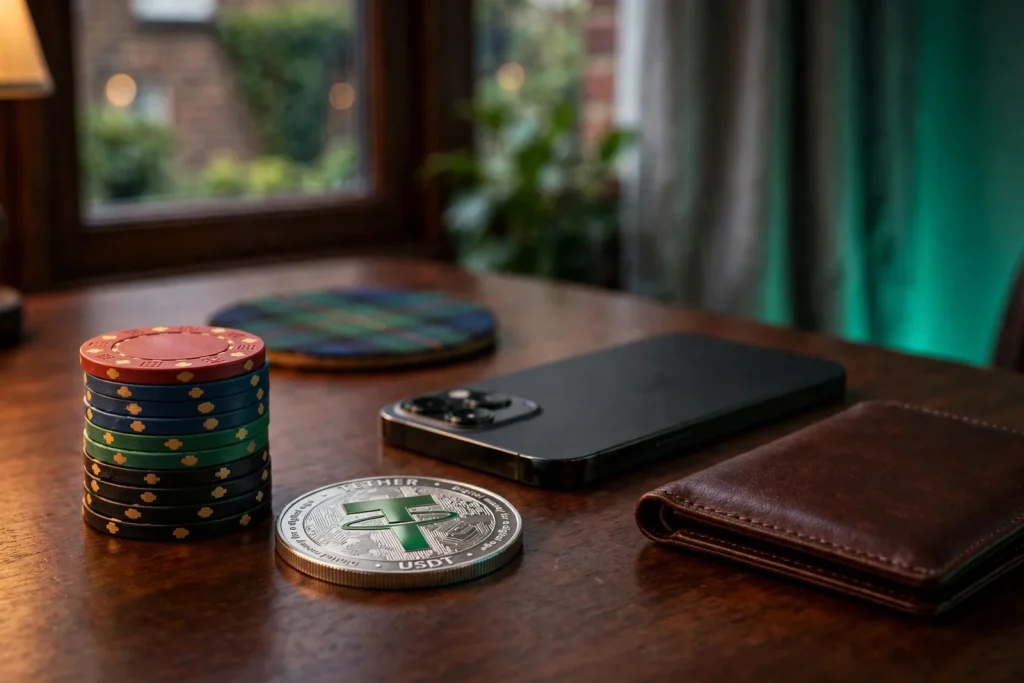
Tether availability depends on the cashier, supported network and account details; promotional wording alone may not confirm a usable route.
What accepting Tether actually tells you about a casino
A site can describe itself as a Tether casino, or put cryptocurrency among its payment options, without that wording proving that you can deposit Tether there today. I’ve learned not to treat a confident badge or a line on a promotional page as the same thing as an available payment route. It may be broad marketing language, an old description, or a reference to crypto generally rather than Tether specifically.
That distinction matters if you are looking for casinos that accept Tether in the UK. A page can mention several ways to pay without confirming that each one is available to every customer. A specialist review of casino payment pages, for instance, described sites listing Visa, Mastercard, bank transfer, e-wallets and several cryptocurrencies. That gives you a sense of the range of methods casino pages may name; it does not establish that a particular casino currently accepts Tether.
Crypto wording can also blur useful differences. “We accept crypto” sounds definite, but it does not tell you which digital currency is supported or whether the option is offered to you. “Tether accepted” is more specific, but it still needs to match what the casino makes available when you are signed in and ready to pay. A label on a landing page is a lead to check, not a green light.
I used to take the broad claim at face value. The awkward part came later: the information that had persuaded me to open an account did not settle what I could actually use. That is not a reason to assume every claim is false. It is a reason to keep the claim in its proper place until the payment screen backs it up.
The cashier is the practical reference point. That is where the casino presents the payment methods available for your account, rather than merely describing its offering in general terms. If Tether is not shown there, do not infer that a generic crypto logo means you can use it. If it is shown, read the wording on that screen before going further. Availability can be presented differently from one site to another, so I would not assume that a method seen at one casino will carry over to the next.
Casinos That Accept Ukash in the UK: What to Check
This is a basic distinction, not a technical verdict. Seeing Tether listed tells you that the casino is presenting it as an option; it does not, by itself, answer every question about how a payment will work. In particular, a general acceptance claim is not enough to establish that a particular network or route is compatible. Those details need their own confirmation, not a guess based on a token name or a logo.
The same goes for claims that a casino is “crypto-friendly”. That phrase may sound like a useful description, but on its own it is vague. It could refer to one cryptocurrency, a group of payment options, or simply the way the site chooses to promote itself. I would look for the actual currency named in the casino’s payment information, then confirm that it remains available in the cashier. Words can be polished. The option itself is harder to misread.
There is a separate question about cost, too. A site saying it accepts Tether does not tell you what the whole transaction may cost, or whether the exchange rate involved changes the amount you receive. Those are sensible things to examine before paying, but they should not be confused with whether the payment method is supported in the first place. First establish what the casino offers; then assess the terms attached to using it.
For a UK player, the operator’s legal status is another matter that should not get lost in the crypto label. Remote gambling businesses serving customers in Great Britain must hold the relevant Gambling Commission licence, wherever the business is based. A Tether option does not tell you whether a casino meets that requirement. Treat payment claims and licensing as separate checks, rather than letting one make the other feel settled.
Do
- Use the cashier as the practical reference point
- Confirm the specific payment route in the deposit area
- Treat licensing and payment claims as separate checks
Don’t
- Assume a general crypto logo means Tether is available
- Treat a landing page label as a green light to pay
- Let a “crypto-friendly” label settle the operator’s legal status
My short version is simple: a Tether label tells you what the site wants you to notice. The cashier tells you whether Tether is presented as an available payment option for your account. Neither a list of cryptocurrencies nor a broad claim about crypto should be stretched into a promise about every detail of using it. Check what is actually offered, and keep the different questions separate. That saves guesswork.
Our top casino picks for the UK
- ChanzeBonus: Slots Welcome Bonus #1 200% up to €500 · Payout speed: 1-3 business days
- AmunbetBonus: Join now and get 450% up to 2,700 GBP + 450 FS · Payout speed: 1-3 business days
- x3betBonus: Welcome Pack 100% Up to £1.000 + 200 Free Spins · Payout speed: 1-3 business days
- Revery PlayBonus: 100% up to€1,000+ 100 FS · Payout speed: 1-3 business days
- NightLuckBonus: Welcome Pack + 805% Up To 6400€ + 280 FS · Payout speed: 1-3 business days
- BritsinoBonus: Welcome Package – Get your £2,200 + 2,000 FS · Payout speed: 1-3 business days
Checking Tether at the online casino cashier
A casino’s homepage can make its payment options sound broader than they are. I’ve learned to treat a row of logos or a “crypto-friendly” label as a starting point, not proof that you can deposit with Tether. The practical check is the cashier: it shows the options available for that casino and, where applicable, for your account.
Start by signing in and opening the deposit area, but do not confirm a payment just to see what happens. Look for Tether by name or for a clearly described stablecoin option. A general reference to cryptocurrency is not enough to establish that Tether is supported. If the cashier names a different coin, or offers a broad category without identifying what it includes, you still need a clear answer before proceeding.
That distinction matters because payment menus are not identical from one site to another. Even two casinos using similar promotional language may show different deposit choices. An old review, a search result, or a graphic on the homepage can be useful for finding what to investigate, but it cannot tell you what is enabled in your cashier right now. I would not deposit on the strength of a third-party list alone. Check the live options.
Casinos That Accept Ethereum in the UK: What to Check
What to look for before selecting a method
Read the payment name and any short description beside it. The cashier should make clear whether the option is Tether, rather than simply “crypto” or “digital assets”. If the label is unclear, pause and ask the casino’s support team to confirm which payment methods are currently available to your account. Save the answer if it is given in writing; it is easier to refer back to a direct response than to guess from a logo.
Also check whether the method is presented as a deposit option. A payment brand appearing somewhere on a website does not, by itself, show that it can be used for the transaction you intend to make. The cashier is the useful place to verify availability before you enter payment details or send funds.
A specialist review has reported payment pages listing Visa and Mastercard, but that does not settle whether either card is available to you at a particular casino. Current UK availability and card-product eligibility need checking in the cashier. In Britain, credit-card payments for gambling are prohibited, so do not treat a card logo as permission to use a credit card. Check that the product you intend to use is eligible.
The same caution applies to claims that an online casino with Tether is “easy to use”. That phrase does not tell you whether Tether appears in the deposit menu, whether the option is available to your account, or whether the casino’s description is current. I have clicked through enough vague payment pages to know that a slogan is not a cashier entry. Small distinction. Important one.
Checking Tether Availability
- Sign in and open the deposit area
- Search for Tether by name or a described stablecoin option
- Verify the method is presented as a deposit option
- Confirm the product is eligible (e.g., not a credit card in the UK)
- Ask support for written confirmation if the label is unclear
Check before you reach the payment step
If Tether is listed, read the instructions shown before continuing. Make sure the payment option is actually selected as Tether and that the cashier has not directed you to a different method. Do not infer support from a wallet address, a coin symbol, or wording copied from another page. If any part of the flow conflicts with the cashier’s label, stop and ask the operator to clarify rather than improvising.
You can also check the site’s help pages, but treat them as supporting information. They may explain how a payment method works, while the cashier tells you what is currently offered in your account. If the two disagree, do not assume the more convenient version is correct. Ask support which option is active before making a deposit.
Currency is another detail worth noticing during this first check. A specialist review has described GBP as supported on supplied casino pages, but you should confirm the account currency before your first transaction. That way, you know what the cashier is showing you rather than relying on a general statement elsewhere on the site. This is a check, not a reason to proceed if the payment method itself is unclear.
Casinos That Accept eCheck in the UK: What to Check
A simple decision point
Before depositing, I would want the cashier to answer three basic questions: is Tether named as an available method, can I select it for a deposit, and do the on-screen instructions clearly relate to that choice? If any answer is uncertain, leave the transaction unfinished and contact support. There is no prize for being the first to test an ambiguous payment route with your own money.
If the cashier does not show Tether, do not assume it will appear after you have sent funds or that another crypto option is interchangeable. You can revisit the payment page later, or ask the casino whether availability has changed. Until the method is clearly offered, the sensible conclusion is simply that you have not confirmed it.
This check will not tell you everything about a payment. It answers the narrower question that matters before you start: whether the casino is currently presenting Tether as an available deposit choice for you. Get that straight first. Then decide whether to continue.
Slots, site wording and the details worth checking
A site can put Tether beside slots in a headline without telling you much about either. Tether is a payment method, not a type of slot, and the wording does not prove that a particular game accepts it or that you can use it to fund an account. I’d treat phrases such as “Tether slots” as a prompt to inspect the details, not as a description of a special category of games.
Tether is a payment method, not a type of slot; phrases like "Tether slots" are prompts to inspect the details rather than descriptions of a special game category.
The same goes for claims about the “best” Tether casino sites. A polished page or a row of coin logos is not enough to establish which operators currently support Tether, let alone which are best for your needs. I would not trust a recommendation unless it gives information you can check directly with the operator. No glossy ranking fixes that.
What I would look for is a clear distinction between the casino’s general game catalogue and its payment information. A site may offer slots while using “crypto-friendly” as broad promotional language. That does not tell you whether Tether is supported, which games are available to you, or whether the wording is current. Keep those claims separate in your head: one is about entertainment; the other is about how you might pay.
There is also a more important UK detail behind labels such as “non-GamStop”. The label does not establish that a site is suitable for British players or that it is authorised to serve them. Remote gambling licensees taking customers in Great Britain need the relevant UK Gambling Commission licence, even when the company is based elsewhere. An offshore operator outside that system does not become a UK-licensed casino because it mentions Tether, offers slots, or uses familiar-looking branding. I would check the operator’s status rather than let a marketing label do the thinking for me.
That matters when reading claims about a Tether casino site UK players can use. “Available to UK players” and “licensed to serve the British market” are not interchangeable statements. If a page leans heavily on payment slogans but is vague about who operates the site, slow down. The payment method is not a substitute for checking the operator.
Casinos That Accept E-Cheques in the UK
The games themselves have rules worth noticing. Online slots in Britain cannot autoplay: you must initiate each spin rather than set a run of spins going automatically. Each spin must also last at least two and a half seconds. So language suggesting effortless, continuous spins should not lead you to expect an autoplay feature on a British-facing licensed site. A little less friction is not always a benefit. Sometimes it is a safeguard.
Stake limits are another useful reality check when a page talks up slots. The maximum stake for an online slot game cycle is £5 for customers aged 25 and over, and £2 for customers aged 18 to 24. Those limits apply to the game, not to whether you use Tether or another payment method. A crypto logo does not change the rules of play.
When I read a page describing Tether slots or a Tether casino, I separate what it actually says from what the wording invites me to assume. Does it identify the operator? Does it explain whether the claim concerns the games, the payment method, or both? Does it present a broad promise as though it were a verified feature? If those points blur together, I take the claim with a pinch of salt.
The same goes for bonus language placed beside Tether and slot promotions. Seeing the words together does not, by itself, establish that a particular deposit qualifies for an offer. Read the offer’s own conditions before relying on a headline. No assumptions.
UK Licensing
Remote gambling businesses serving customers in Great Britain must hold a Gambling Commission licence, regardless of where the business is based.
BEP20 claims: confirm the network before you pay
A payment page can mention Tether without making clear which network it supports. If you see “BEP20” beside USDT, treat that as a specific instruction, not decorative technical wording. The casino’s payment option and the network selected in your sending wallet need to match. A familiar currency label on its own is not enough.
I’ve learned to slow down at this point. “Supported” sounds reassuring, but it only helps if the details shown for the transaction fit the route you are about to use. Before sending anything, open the casino cashier, choose the Tether option and read the network information displayed there. Then compare it with the network selection in your wallet. If one says BEP20 and the other does not clearly confirm the same route, stop and ask the casino’s support team to clarify. Don’t guess from a logo, an old review or a general page about crypto.
Read the payment details, not just the label
Check what the cashier presents for the actual deposit: the selected currency, network wording and destination details. If those details are unclear, missing or different from what you expected, do not start the transfer. A payment sent using an incompatible network may not reach the account as intended, and sorting out a mistake can be difficult. That is a poor moment to discover that two screens were describing different things.
Casinos That Accept Interac in the UK: What to Check
This is why I would not call a site the best Tether casino UK option simply because its website mentions USDT or BEP20 somewhere. A search result, promotional banner or old payment guide cannot confirm what is available to your account now. The live cashier is the practical checkpoint. If it does not show a clear BEP20 route for the transaction, you do not have a confirmed BEP20 payment option.
Be equally careful if you are looking for a best USDT casino in England or a Tether slot casino. Those phrases say what you want to find; they do not establish which networks a casino accepts. A slot game does not make the payment route compatible, either. Keep the network check separate from the choice of games.
Once the cashier’s instructions are clear, follow them exactly and check the details again before authorising the transfer. If anything changes between selecting the payment method and confirming the transaction, pause rather than relying on what you saw earlier. I would rather lose a minute asking a plain question than send funds on an assumption.
No guesswork.
Limits, account currency and keeping deposits manageable
A Tether balance can look straightforward until the casino asks you to choose an amount or shows an account currency you did not expect. I used to focus on whether a payment button appeared and leave the rest until later. That is backwards: decide what you can afford, then check how the account will record the deposit.
Financial limit controls
Remote gambling licensees must prompt new customers to set a financial limit before their first deposit and ensure that account-level limit controls are easily accessible.
Remote gambling licensees must prompt new customers to set a financial limit before their first deposit and make account-level limit controls accessible. Take a moment to set a limit that fits your own budget, and check where to change it later. It is a useful guardrail, not a way to make a deposit affordable if it is not.
The minimum deposit is another separate check. One specialist review puts the starting point at £10–£20, with the amount depending on the payment method. Treat that as a reported range, not a promise about a particular UK Tether casino: the cashier’s current minimum is what matters. A displayed minimum tells you only what the site will accept, not what you should spend.
Maximums can be just as method-dependent. A specialist review notes that deposit caps may apply per transaction, per day or per month, and can vary with both the payment route and account status. Look for each cap before you enter an amount. If the cashier presents a limit that conflicts with your account controls, pause rather than trying to work around it.
Currency deserves a check before the first transaction. A specialist review reports that GBP is supported on the pages it examined, but that does not establish the currency setting for every casino or account. Confirm the account currency in the cashier or account settings before sending USDT. If the balance is shown in another currency, understand how the casino will display the deposit and whether conversion applies. The label “GBP supported” is not enough if your own account is set up differently.
Casinos That Accept Citadel in the UK: What to Check
I have made the mistake of assuming a payment amount and an account balance would line up neatly. They may not, particularly if the account currency differs from what you expect. Check the denomination shown beside the amount, the minimum and maximum for that payment option, and your chosen financial limit before confirming. Keep the first transaction within the amount you have already decided is manageable; do not increase it just to meet a minimum without reconsidering your budget.
These checks are about control, not finding the largest deposit the cashier will allow. The casino’s limits tell you what its system permits. Your financial limit is the boundary you set for yourself. Keep those two things separate, and confirm the currency before you commit. Small check, real difference.
Using Tether with a casino: match the account details
When I’m looking at a casino that takes Tether, I treat the name on my gambling account and the ownership of the payment route as one practical check. The account should be yours, and the payment method should belong to you too. A mismatch can turn a straightforward transaction into a request to explain who controls the funds. That is avoidable friction, not a clever workaround.
The same principle applies if a Tether casino site lets you deposit through a named account or wallet. Use your own details rather than borrowing someone else’s route, even if they have offered to help. Keep the records that show the payment came from a source you control. If the casino asks for clarification, consistent details are easier to explain than a chain involving other people.
Keep it in your name.
Account Ownership
Always use your own named account and payment route. Using a borrowed route can lead to significant friction and requests for explanation during the verification process.
For deposits and withdrawals, the cleanest route is often the same named account used consistently. That does not mean every casino supports withdrawals through every deposit method, or that Tether will be available for both directions. Check the operator’s rules for the specific payment route before relying on it. A payment option shown for deposits alone should not be assumed to handle a payout.
The original source can matter when you withdraw. Returning funds to the source used for the deposit is a common anti-fraud and anti-money-laundering control. In the UK, anti-money-laundering rules generally require payouts to go back to the original payment source. If you ask for an alternative route, expect that the casino may need to carry out additional checks before approving it.
That point is easy to overlook when searching for a Tether casino list in the UK: a method that appears convenient at deposit stage is only part of the picture. Before sending funds, understand which account or route is recorded as the source and how the operator handles a return. If the payment route belongs to someone else, or you plan to switch routes later, ask the casino what it requires rather than assuming the change will be automatic.
I used to focus on whether a payment button appeared and leave the ownership details until later. That was backwards. Match the casino account to a payment route you control, keep the same route where possible, and make sure you understand how a withdrawal would be returned. Boring, but useful.
Casinos That Accept Maestro in the UK: Payment Guide
Crypto payment costs: check the full amount
A crypto deposit can look fee-free at the casino’s end and still cost more than you expect. I’ve learned not to stop at the amount shown beside the deposit button: the useful figure is what leaves your wallet compared with what arrives in the casino balance.
A specialist payment review identifies several possible parts of the cost: a casino charge, a payment-provider fee, a fee from an issuer or bank, a conversion spread and a network fee. Which of these applies depends on the route and the transaction. Don’t treat that list as a tariff for every Tether crypto casino; it is a checklist of places where a charge may arise, not proof that a particular operator applies one.
The exchange rate deserves a proper look. If your balance or the casino account is not held in the same currency as the value being sent, a conversion may happen along the way. A specialist review notes that the spread built into an exchange rate can cost more than a clearly displayed flat fee. That can be easy to miss: there may be no separate line labelled “conversion charge”. Compare the rate you are offered with the rate used to calculate the credited amount, where both are shown.
For a USDT casino transaction, check the displayed debit and credit amounts, then read the casino’s payment terms and the wallet or provider’s fee information. Look for charges on the casino side as well as any fee shown before you approve the transfer. If the rate or fee is unclear, pause rather than guessing. A small-looking deduction can change the amount that reaches your balance.
Potential Costs
Costs can arise from multiple sources, including casino charges, payment-provider fees, issuer/bank fees, conversion spreads, and network fees.
There is no universal cheapest method. Compare the casino charge, provider fee, conversion spread and network cost for the amount you actually intend to send. A route that looks inexpensive for one transfer may not be the least costly for another. The total matters.
That is separate from network compatibility. A low fee does not mean the casino supports the network you plan to use, and a network label alone does not tell you the full cost. Check the network the cashier accepts before sending anything; assess the charges as a second, distinct check. Don’t mix those decisions.
TRC20 and ERC20: don’t assume the networks are interchangeable
When a cashier lists Tether, the name of the token alone is not enough. TRC20 and ERC20 are network labels, and a Tether option on one network should not be treated as the same payment route as an option on the other. I’d check the exact wording in the cashier before doing anything else.
That distinction is easy to miss when you are scanning a payment page. “USDT accepted” can sound like a complete instruction, but it does not tell you which network the casino expects. Look for a specific TRC20 or ERC20 selection, then make sure the payment screen gives you the matching route. If the cashier does not make that clear, stop and ask the casino’s support team rather than guessing.
Casinos That Accept Neosurf in the UK: What to Check
The same check applies whether you searched for a Tether TRC20 casino in the UK or an ERC20 Tether casino. Those phrases describe different network choices, not proof that a particular site accepts either one. A casino may mention Tether generally while leaving the supported network unclear, or its payment options may differ from what an older page says. The live cashier is the place to verify the current instruction.
Before confirming a transfer, compare the network shown by the casino with the network selected in the wallet or service you are using. Check the whole payment instruction, not just the USDT ticker. If the details do not match exactly, do not send funds until the casino clarifies what it supports. No guesswork.
I would also check the cashier again if you return later to make another deposit. Payment options can change, and remembering what appeared previously is not a substitute for reading the current screen. The key point is simple: a reference to Tether does not automatically confirm TRC20 or ERC20 support.
Treat any claim about a “TRC20 Tether casino” or “USDT ERC20 casino” as a prompt to verify the exact network, not as a recommendation. Confirm the named option before transferring, and only proceed when the cashier’s instructions and your selected network agree.
Tether bonuses and the terms behind the offer
A Tether deposit and a bonus are two separate things. I learned not to treat a payment option as proof that a promotion will apply: the offer may have its own eligibility rules, and the wording in the cashier does not replace them.
Bonus Eligibility
Attention A Tether deposit does not automatically qualify you for a promotion. Always check the full terms to see if Tether is specifically named, excluded, or left unclear.
Before accepting a Tether casino bonus, open the full terms and look for the permitted deposit methods. Check whether Tether, USDT or the specific payment route you plan to use is named, excluded or left unclear. If it is unclear, ask the casino’s support team before depositing and keep a copy of the reply. A banner saying “welcome bonus” is not enough to settle the question.
Then read the conditions attached to the offer itself. A deposit promotion may set rules about who can claim it, which games count towards any wagering requirement, and what happens if you opt in or make a qualifying deposit. A no-deposit offer can have separate eligibility rules too; the fact that you do not need to deposit does not mean it is available to every account. Check the actual terms rather than relying on the label.
I also separate bonus eligibility from payment convenience. A specialist review has reported that PayPal can be excluded from some promotions, while Skrill and Neteller are often excluded at sites that offer them. That does not tell you how a particular casino treats Tether. The only useful answer is the current wording for the offer you intend to claim.
Be wary of “anonymous” language around a USDT casino bonus. A crypto payment does not, by itself, establish that a promotion is available or that its terms can be skipped. Read the operator’s conditions, including any account and verification requirements, before you opt in. If the terms conflict with the banner or do not name your payment method clearly, pause rather than assuming the more generous interpretation.
My rule is simple: confirm the offer, payment eligibility and conditions before sending money. A bonus is only worth considering when you understand what claiming it requires. No guesswork.
Casinos That Accept Zimpler in the UK: What to Check
No-KYC claims and withdrawal verification
“Tether casino no KYC” can sound like a promise that you will never be asked to prove who you are. I would treat that wording carefully. A crypto payment does not, by itself, settle what checks a casino may require before approving a withdrawal. In Britain, remote gambling licensees serving customers must hold a Gambling Commission licence; a claim of anonymous play should not be mistaken for a way around the operator’s checks.
The point where the promise can feel less clear is cashing out. A specialist review notes that a first withdrawal may take longer when the casino is still completing verification. That is worth keeping in mind before depositing: an account that has not yet been fully checked may not be ready for a payout to be processed. I would not read “no verification” on a payment page as a guarantee that no checks can arise later.
There is another step between requesting a withdrawal and receiving it: the casino’s own approval. Processing time can depend both on that internal review and on whether your account is already verified. So even if a deposit appears straightforward, that alone tells you little about how quickly a later withdrawal will be cleared. No shortcut.
Before you play, read the operator’s terms for its verification process and withdrawal conditions, and make sure you can provide the information it may request. If the wording is vague, ask the operator directly rather than relying on a banner or a broad “no-KYC” label. Keep a copy of the relevant terms, too; promotional wording and the detailed rules are not always the same thing.
I have learned not to treat “anonymous” as a synonym for “payout without questions”. A realistic expectation is that verification may be needed, particularly around a first withdrawal, and that the casino must still approve the request. That is less exciting than the headline. It is also the part that matters when you want your funds back.
Do UK casino withdrawals require verification?
Yes, casinos may need to verify your account before approving a withdrawal, and first withdrawals can take longer while checks are completed.
Why must withdrawals return to the deposit method?
Returning funds to the original payment source is a common anti-fraud and anti-money-laundering control. Using a different route may require extra verification.
Why can a fast payout casino still delay my withdrawal?
A casino’s internal approval and any outstanding account verification can delay a payout. Delivery may also take longer because of payment cut-off times or weekends.
Can I deposit in GBP?
Yes, GBP is supported, but check that your account is set to GBP before depositing to avoid currency conversion.
What is the current minimum deposit?
The minimum deposit usually starts at £10–£20, depending on the payment method.