
Casino Sites That Accept Debit Cards in the UK
 Available in GB
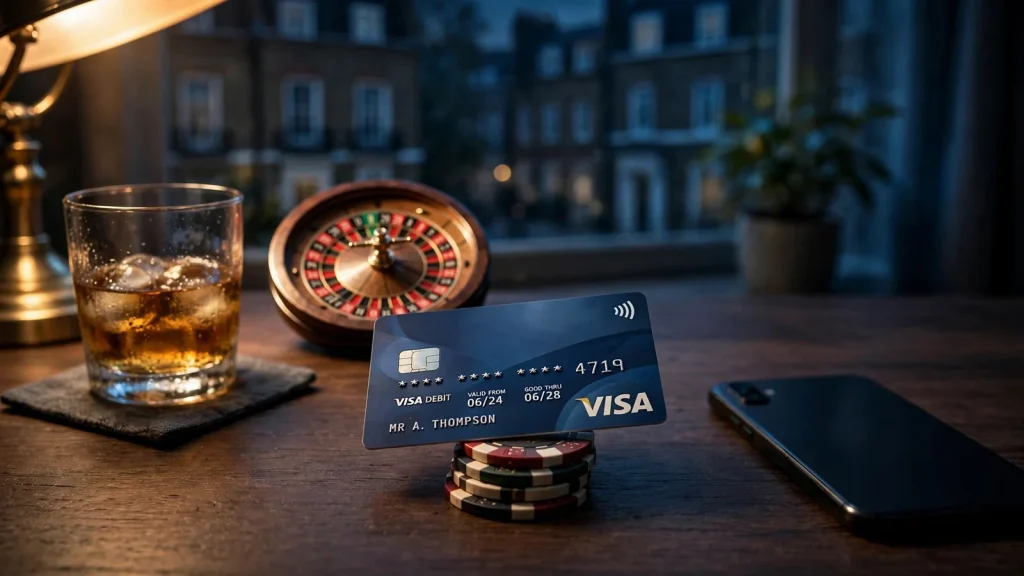
A listed Visa or Mastercard option does not guarantee that every card or issuer will work at checkout.
What “accepts debit cards” actually means
When a casino says it accepts debit cards, it means card payments are among the methods it lists for customers. In the UK, Visa and Mastercard are common choices. That is useful as a starting point, but the logo is not a promise that every card carrying it will work.
I used to treat a familiar logo like a green light. It isn’t. A payment method can be listed while a particular card is declined, or the cashier may not offer that card route at all. “Accepted” describes the casino’s available payment channel; it does not confirm that your card, its issuer and the transaction will all be compatible.
That distinction matters when you’re comparing casino sites that accept debit cards. A page describing Visa or Mastercard support may tell you what the operator intends to accept, but the live cashier is where you can see what is available for your account at that time. Current UK availability and the eligibility of particular card products need checking there. A static logo can’t show you every restriction.
The logo is only the first check
Visa and Mastercard are payment networks, not a guarantee about the individual product in your wallet. Your card may be debit, prepaid or another product, and the payment route can depend on details that are not obvious from the logo alone. The operator’s list and the cashier’s live options matter more than an old mention on a review page or a badge in a footer.
There is also a difference between a casino supporting a network and your bank approving a payment. The casino may make a card option available, yet the transaction can still fail elsewhere in the chain. A declined attempt does not necessarily mean the casino never accepts debit cards; equally, seeing the logo does not establish that the payment will go through. I learned not to read too much into either outcome.
“Works with Visa” sounds definitive. In practice, it means you need to check the actual card route. Small wording, big difference.
Casino Payments in the UK: Compare Deposit Methods
The same caution applies if you are looking at several debit card casino sites. Two casinos can show the same network logos but present different options in their cashiers. Even at one casino, what is visible can depend on whether you are signed in and on the card product being used. The safest interpretation is modest: the operator says it supports a network, and you still need to confirm that your card is eligible.
Debit is not credit
The word “card” can blur an important line. Debit cards draw on money held in an account; credit cards borrow against a credit facility. UK rules prohibit credit-card payments for gambling, while debit cards are a separate payment category. The regulator introduced the credit-card gambling ban on 14 April 2020, and it remains in force.
So a casino that accepts debit cards is not offering the same thing as one that takes credit cards. Don’t assume that every card-shaped payment product is treated alike, or that a card logo overrides the rules. What matters is the product and the payment route, not just the plastic or digital card image on your screen.
That is why “debit card casino sites” is a broad description, not a guarantee about every customer’s card. The operator may list Visa and Mastercard, but you still have to match that listing to the product you hold and the option shown to you. If the cashier does not display a supported route for your card, the general logo is not enough to make it eligible.
Read “accepted” narrowly
I’d read the word as a claim about the site’s stated payment methods, not as a personal approval. It doesn’t tell you that your particular issuer will authorise a transaction, that your card product qualifies, or that the route will be available in every visit. Those are separate checks, and the cashier is more useful than a broad claim on a landing page.
This also keeps comparisons honest. A site may belong on a list of casinos that accept debit cards because it offers Visa or Mastercard, but that label cannot tell you whether your own card will be accepted. Avoid treating “best” or “top” as a payment guarantee either; those words do not change the practical test. Check the cashier’s displayed method against your card.
Attention: A payment logo is only a signpost; it does not guarantee that your specific card, its issuer, or the transaction will be compatible.
I’ve made the mistake of seeing a familiar payment logo and assuming the rest was settled. It wasn’t. Treat the logo as a signpost, then confirm the exact card option before relying on it. That is what “accepts debit cards” actually gives you: a useful starting point, not a promise about your individual payment.
Our top casino picks for the UK
- ChanzeBonus: Slots Welcome Bonus #1 200% up to €500 · Payout speed: 1-3 business days
- AmunbetBonus: Join now and get 450% up to 2,700 GBP + 450 FS · Payout speed: 1-3 business days
- x3betBonus: Welcome Pack 100% Up to £1.000 + 200 Free Spins · Payout speed: 1-3 business days
- Revery PlayBonus: 100% up to€1,000+ 100 FS · Payout speed: 1-3 business days
- NightLuckBonus: Welcome Pack + 805% Up To 6400€ + 280 FS · Payout speed: 1-3 business days
- BritsinoBonus: Welcome Package – Get your £2,200 + 2,000 FS · Payout speed: 1-3 business days
Making a debit-card deposit without surprises
The cashier is where a general promise about card payments meets the details of your account. Before you type in a Visa debit card number, open the deposit screen and check that the card option is actually available to you. A logo on a casino’s information page is not enough: the cashier shows what the site is currently offering, and the options can depend on your account or payment route.
I’ve learned not to treat the first amount shown as a harmless suggestion. Check the minimum for the method you have selected, then compare it with the amount you intended to deposit. A specialist review I read reports that minimum deposits often fall in the £10–£20 range, with the exact figure depending on the payment method. That is a guide, not a promise for every cashier. If the displayed minimum is higher than you planned, stop and decide whether you still want to proceed.
The maximum matters just as much, especially if you are making a larger deposit. The cashier’s terms may set a ceiling for one transaction, while separate daily or monthly limits can apply. A specialist review describes those maximums as varying with the payment method and the player’s account status. So don’t assume that a card limit you saw elsewhere applies to your own account. Read the on-screen limit and any linked payment terms before confirming.
UK Casino Sites That Accept EcoPayz: What to Check
Pay attention to the wording around the amount field. Some screens ask for the deposit amount first; others show a minimum, maximum, or both beside the selected method. If the currency is not clear, or the amount changes when you choose a different option, pause rather than clicking through. A small mismatch is easier to catch before authorisation than after you have sent the payment.
Then check what the confirmation screen is asking you to approve. Make sure the amount is the one you chose, the selected method is your debit card, and the card details are entered in the intended fields. If anything looks unfamiliar, don’t guess. Go back to the cashier or contact the operator through its support channel. A declined payment can be frustrating, but repeatedly submitting the same details without understanding the message is no fix.
A card deposit can be credited instantly, according to a specialist review I checked. That describes a possible deposit experience, not a guarantee that every transaction will clear at once. Authorisation can still fail, and a cashier may show a pending state while the payment is being handled. Keep the confirmation or transaction reference if one appears. If the balance does not update, check the account activity and payment status before trying again; otherwise you could end up with more than one request in progress.
Before making the first deposit, there is another step that should not be skipped: remote gambling operators must ask new customers to set a financial limit before accepting that first payment. The account should also give you access to limit controls after setup. Take that prompt seriously. Choose a boundary that reflects what you can afford to lose, rather than raising it just to get past the screen. I have made the mistake of treating a control as admin. It isn’t.
Do
- Check the minimum and maximum deposit limits in the cashier
- Set a financial limit before making your first payment
- Verify your age according to the account instructions
Don’t
- Assume the first amount shown is a harmless suggestion
- Treat financial limit controls as mere admin tasks
- Repeatedly submit payment details without understanding the error
The operator must also verify your age before allowing a deposit. If the account is waiting for an age check, completing payment details will not necessarily move things along; follow the account’s instructions instead. That can feel like one more hurdle when you are ready to play, but it is better to understand the account status than to keep attempting a payment that cannot yet be accepted.
Finally, don’t read an instant deposit as a promise about getting money back at the same pace. A specialist review notes that a card payment may arrive promptly while a payout can take several business days. Those are different parts of the transaction, with separate handling. For this step, keep your attention on the amount, the cashier’s limits, the payment confirmation and the account prompts. Check first. Then decide.
Which payment methods work for deposits and withdrawals?
When I compare payment routes, I separate two questions: can I put money in, and can I get a withdrawal through the same method? A method appearing in the cashier answers only the first question unless the site also confirms that it handles payouts. That distinction matters more than a long row of payment logos.
Visa and Mastercard debit cards are familiar deposit options at UK casinos, and some sites also support card withdrawals. But “accepts debit cards” does not necessarily mean that every card product works for both transactions. Check the cashier’s separate deposit and withdrawal information rather than assuming the route works in both directions.
Casinos That Accept Wirecard in the UK: Payment Checks
That is the useful comparison point. A debit card may feel like one straightforward route, but the casino’s payment rules determine whether it can be used for a payout too. I would treat each direction as a separate feature.
Routes that may work both ways
Bank transfers and open-banking services can support deposits and withdrawals at many sites. A specialist casino review describes them as routes that can provide instant deposits and fast withdrawals, but that is not a promise for every operator or transaction. The cashier’s current options are the thing to check.
PayPal is another name you may see when comparing payments. A specialist casino review presents it as a popular option for speed and convenience, while noting that bonus eligibility may be restricted. Those details can change between operators, so read the payment and promotion terms together rather than assuming that a method qualifies.
Skrill is described in specialist casino coverage as one of the common deposit options at UK-facing sites. Neteller is also available at some casinos. Both may be excluded from promotions, so check the specific offer before using either. Their appearance in a cashier does not, by itself, confirm that withdrawals are supported.
These methods are not interchangeable just because they are all electronic. For each one, look for an explicit withdrawal option as well as a deposit option. Small detail. Big difference.
Deposit-only methods
Paysafecard is a prepaid voucher for deposits only. It can put funds into an account, but it is not a route for receiving a casino withdrawal. If you choose it, think ahead about how a payout would be handled; the deposit method alone does not settle that question.
Deposit-only methods
Paysafecard is a prepaid voucher used exclusively for deposits and cannot be used as a route for receiving casino withdrawals.
Apple Pay is accepted for deposits by some UKGC-licensed casinos. Its presence is useful if you want to pay through a supported mobile wallet, but do not infer that it can receive withdrawals. Check the site’s stated payout methods separately.
Jeton still appears at a handful of UK online casinos in 2026, according to a specialist casino review. Availability is limited, and a listing does not tell you whether the method works for withdrawals. Confirm both functions with the operator before relying on it.
Match the method to the transaction
For a quick comparison, I would write down the method and mark whether the casino supports deposits, withdrawals, or both. Card, bank-transfer and e-wallet labels can otherwise blur together, especially when a page lists payment options without explaining what each one can do.
This is also where “top” or “best” lists can be misleading: a payment option is only useful if it fits the transaction you need. If you want to play slots with a debit card, check the deposit route first; if you also expect a payout to that card, verify that separately. The same rule applies to any alternative method.
Do not assume a deposit-only option is a problem, but do know what happens next. The casino may offer a different withdrawal route, subject to its own rules and checks. The practical comparison is not simply which logo looks familiar. It is whether the method supports the movement of money you actually need, in both directions where required.
Debit-card casinos and the real cost of moving money
A debit card can look like a straightforward way to fund a casino account: the amount appears in the cashier, you confirm it, and the payment goes through. But the figure on that screen is not always the whole cost. I’ve learned to look past the word “free” and ask what might be happening between the casino, the payment provider and my bank.
Casinos That Accept Bitcoin in the UK: What to Check
A payment-cost breakdown in a specialist review identifies several possible charges: a fee from the casino, a payment-provider fee, a charge from the card issuer or bank, a currency-conversion spread, or a network fee. Not every transaction attracts every charge, and the terms depend on the parties involved. The useful point is that a missing casino fee does not prove that moving the money costs nothing.
Check the currency before comparing fees
For UK debit card casinos, the account currency matters. A specialist review of the supplied casino pages reports that GBP is supported, but that does not tell you which currency a particular account will use. Confirm it before your first transaction. If the account and card operate in different currencies, conversion may enter the calculation.
That conversion can be easy to overlook. You may see the amount you intend to deposit, but the bank or payment service may apply its own exchange rate when processing the transaction. The difference between that rate and a market reference rate is the exchange-rate spread. A specialist review notes that this spread can cost more than a visible flat fee. So a payment advertised with no fixed charge can still work out less favourably than one with a clearly stated fee.
It is worth checking where the conversion happens, too. Depending on the arrangement, the casino, the payment provider or your card issuer may be involved. The rate shown at one stage may not be the final rate applied by another party. I would not assume the cashier’s displayed amount settles every part of the calculation.
Possible payment charges
A transaction may incur several costs: a casino fee, a payment-provider fee, a charge from the card issuer or bank, a network fee, or a currency-conversion spread.
Compare the whole transaction
There is no universal cheapest route for every player or every payment. A specialist review’s cost comparison recommends looking at the casino charge, provider fee, currency spread and network cost for the actual amount you plan to move. That last detail matters: a fixed charge has a different effect on a small transaction than on a larger one, while a percentage-based conversion cost changes with the amount.
For a Visa debit card or Mastercard, check your casino’s payment terms and your bank’s card fees rather than relying on a general claim about debit cards. The card logo alone cannot tell you whether your issuer will charge for a particular transaction or how a conversion will be handled. The same caution applies when comparing one casino with another: a payment label is not a complete price list.
If you are weighing a card against another route, compare like with like. Look at the same account currency and intended amount, then include any stated casino and provider charges alongside possible bank and conversion costs. Do not pick a method on the basis of one line saying “no fee” if other parts of the transaction remain unclear.
The practical check is not complicated, but it is easy to skip when you are focused on getting the payment done. Read the cashier’s fee information, confirm the account currency, and check your card issuer’s terms. If the total remains uncertain, ask the provider or bank how it handles the transaction before you proceed. A small visible fee is only one part of the price.
Casinos That Accept Instadebit in the UK: What to Check
What makes a debit-card casino a better fit?
“Best” is doing a lot of work in a phrase like best debit-card casino. I would not treat it as a promise of better odds or a smoother experience for everyone. The better fit is the site whose payment setup, account controls and withdrawal arrangements suit how you actually want to manage your money.
Start with the cashier, not a badge on a homepage. A casino may display Visa or Mastercard, but that alone does not confirm that your particular card will be accepted for a deposit. Check the payment options shown after signing in, and read any terms attached to the card method. If the route you intend to use is not clearly available, do not assume you can sort it out later.
Then look beyond getting money in. I used to focus on the deposit button and treat the rest as a problem for future me. That was backwards. Before choosing a debit-card deposit casino, find out how the site handles withdrawals and whether it expects funds to go back through the payment route used to deposit. A single named account used consistently for both directions can make the arrangement clearer. The specific routing rules still matter, so check the cashier information rather than guessing.
Financial controls deserve the same attention as payment compatibility. Remote gambling licensees must make new customers set a financial limit before their first deposit, and the account should provide accessible controls for changing or managing limits. I would check that those tools are easy to find and make sense to use, rather than clicking through the setup screen just to reach the games. A control you cannot locate later is not much of a control.
Choosing a Better Fit
- Check that Visa or Mastercard options are available after signing in
- Verify how the site handles withdrawals and original payment routes
- Locate and test the financial limit controls
- Confirm the UK Gambling Commission licence and number on the public register
Licensing is another basic part of fit, not a decorative detail. For a casino serving customers in Great Britain, check that it has the relevant UK Gambling Commission licence and verify the licence number on the Commission’s public register before depositing. A payment method being available does not replace that check.
I would also consider how clearly the site explains its terms. Can you find the payment conditions, withdrawal information and account controls without digging through vague promotional language? If a banner says “instant” or “seamless”, I look for the actual conditions behind the word. Clarity is more useful than a polished promise.
Finally, think about whether the payment setup matches your habits. If you want to keep casino spending separate, a dedicated account may help you track it; if you prefer one route throughout, check that the site supports that route for both deposits and payouts. Neither preference makes a casino objectively better. What matters is that the arrangement is understandable before you put money in.
That is my test for a better fit: compatible card options, visible financial controls, clear terms and a payment setup that makes sense beyond the first transaction. No trophy list. Just fewer avoidable surprises.
Why casinos may return withdrawals to your card
When I first used a debit card at an online casino, I assumed a withdrawal would simply go wherever I asked it to go. That sounds reasonable, but payment routing does not always work like sending money between friends. A casino may need to return funds to the source used for the deposit.
Casinos That Accept iDEAL in the UK: What to Check
For UK gambling, anti-money laundering rules are part of the reason. Returning a payout to the original payment source is a common control against fraud and money laundering. So if you used a debit card to fund your account, the casino may send the withdrawal back to that card rather than letting you choose an unrelated destination.
That can catch you out if you have found a casino that accepts debit cards and are thinking only about how easily you can pay in. The route out matters too. A card deposit does not, by itself, promise that every payout will be credited in the way you expect. The casino’s payment process and its checks determine what happens next.
I once treated the cashier’s payment options as a simple menu: pick one to deposit, pick another to withdraw. That was the wrong mental model. The operator may link the two transactions, and the original source can take priority when it processes a payout. Not a free choice.
If you ask to receive the money by a different route, the casino may need additional verification before it agrees. That does not automatically mean there is a problem with your account; it can be part of checking that the change is legitimate and that the funds are going to the right person. Still, it may add friction, especially if the details you provide do not line up with the account information the casino already holds.
This is why I would not judge an online casino that accepts debit card deposits only by whether the card appears in its deposit options. Before relying on a particular withdrawal route, read the cashier’s terms or ask support how it handles payouts after a card deposit. Check whether the original card is expected to be used for the return and what the operator requires if that route is unavailable or you request an alternative.
Anti-Money Laundering
To prevent fraud and money laundering, casinos may require payouts to be returned to the original payment source used for the deposit.
A “flexible withdrawal” claim can sound reassuring, but the useful detail is the actual process: whether the original payment source takes precedence and what checks apply if it cannot be used. A best casino that accepts debit cards is not necessarily the one with the longest list of payout buttons. The top casino that accepts debit card deposits, if you are comparing options, is one whose rules you can understand before money is in the account.
Keep the distinction clear: this is about where a payout is routed, not a guarantee about when it will arrive. The original-source control can shape the destination, while other parts of the withdrawal process determine timing. Read the rule first. It saves a surprise later.
Choosing a card route that avoids payment friction
When you are comparing casinos that accept debit cards, the logo in the cashier is only part of the picture. The details attached to the payment matter too. I try to keep the casino account and the card route in my own name, rather than mixing accounts that belong to different people. It is a small check, but it can prevent basic ownership questions from getting in the way of a transaction.
That matters even when the card itself is accepted. A payment route belonging to someone else may not line up with the account details the casino has on file. If that happens, you can end up having to clarify who owns the payment method before things move forward. Keeping the same customer behind both sides reduces that avoidable friction; it does not guarantee every payment will be approved.
I would not use a partner’s or family member’s card just because it is handy, or switch between another person’s payment account and my own casino account. Shared household finances can make the distinction feel trivial at home. A payment check may not see it that way. Keep it simple.
The same idea applies if you use more than one route: know which account belongs to you and use it consistently where possible. If a transaction is questioned, clear ownership details are easier to explain than a tangle of names and accounts. That is not a clever workaround or a way to bypass checks; it is simply avoiding a mismatch you did not need to create.
A card route that fits your own account is therefore a practical part of choosing among debit-card casinos. The “easy” option is not necessarily the one with the flashiest payment panel. It is the one you can use as yourself, with details that match.
Can you use a debit card for online gambling in the UK?
Yes. You can use a debit card for online gambling in the UK, provided the casino accepts your card and you meet its account requirements. UK casinos commonly list Visa and Mastercard debit cards as payment options. That does not mean every card or transaction will be approved, but debit cards are a separate category from credit cards under the gambling rules.
The distinction matters. The regulator banned credit-card gambling on 14 April 2020, and the ban remains in force. Remote gambling licensees must not accept credit-card payments for gambling, including credit-card funds routed through a money service business. A credit card is not made acceptable by adding another step between it and the casino.
Credit Card Ban
UK rules strictly prohibit the use of credit cards for gambling; remote gambling licensees must not accept these payments.
Debit cards are not covered by that ban. So, in principle, you can deposit at an online casino with a debit card. The cashier must still support the card and your bank may apply its own checks. A card bearing a familiar logo is not a promise that a particular payment will go through.
There is another boundary worth keeping clear: legality depends on the operator, not just the payment method. In Great Britain, a remote gambling operator serving customers must hold the relevant UK Gambling Commission licence. Being able to reach a site or see a debit-card option does not, by itself, establish that the site is licensed.
I used to treat the payment logo as the whole answer. It isn’t. Debit card: permitted category. Credit card: prohibited for gambling. The casino’s acceptance and your own card’s eligibility are separate questions, and the cashier is where you confirm the practical one.
Before you join using a debit card, check the details
Before signing up at a UK debit-card casino, I check two things that are easy to overlook: the currency on the account and whether the payment route belongs to the same person as the account. Neither tells you everything about how a site handles payments, but both can prevent an avoidable snag later.
Start with the currency shown during registration or in the account settings. A specialist casino review reports GBP as supported at the sites it checked; that is not a promise that every casino offers it, or that the setting will suit every account. Confirm the currency before your first transaction. If the account is set to another currency, a card payment may involve conversion, which can affect the amount charged or credited. Better to spot that before entering payment details.
Then make sure the casino account and debit card are in your own name. I would not register using one person’s details and try to pay with another person’s card. Even if the payment appears to go through, a mismatch can raise questions about ownership and interrupt a transaction. Keeping the account information and payment route tied to the same customer is the cleaner approach.
Take a moment to read the registration fields rather than rushing through them. Use the same personal details you expect to use for the payment, and check for typing errors before submitting the form. Small inconsistencies can turn a simple setup into an unnecessary back-and-forth.
If you are comparing options and asking which casino you can join with a debit card, do not rely on a general label alone. Check the casino’s own account and payment information, confirm GBP is available for your account, and make sure the card route is yours. Those checks will not guarantee a smooth transaction, but they remove two basic sources of friction.
A little care up front. Much less untangling later.
A quick check before your first card deposit
Before you press the deposit button, I’d do one last pass through the cashier. A payment logo tells you a route may be supported; it does not confirm that your specific card will be accepted for this account.
- Check the card option is available. Look for Visa or Mastercard in the live cashier, then read any notes about card eligibility.
- Confirm the amount and currency. Make sure the minimum deposit suits you and that the account is set to GBP if you want to avoid an unintended conversion.
- Read the transaction terms. Check for any casino or payment-provider charge before confirming. A cost can sit in the exchange rate rather than appear as a separate fee.
- Know what may happen at withdrawal. Closed-loop rules can mean funds are returned to the original payment source. A card deposit being instant does not mean a later payout will be.
- Leave room for checks. The casino’s internal approval process affects withdrawal timing, and a first payout can take longer while KYC is completed. I’ve learned not to treat a pending withdrawal as proof that something has gone wrong.
One last pause. If the cashier’s details match what you expect, you can make an informed choice; if they don’t, stop and check with the casino before sending money.
Why must withdrawals return to the deposit method?
Returning funds to the original payment source is a common anti-fraud and anti-money-laundering control. Using the same account and payment route for both transactions can also reduce avoidable ownership checks.
What is the fastest withdrawal method for UK casinos?
PayPal, open banking services and debit cards linked to fast payout systems are generally among the quickest options. The actual speed also depends on casino approval and whether your account is verified.
Are fast casino withdrawals guaranteed?
No. Withdrawal speed depends on the casino’s approval process and your account’s verification status.
Which payment methods are accepted in Great Britain?
UK casinos commonly accept Visa and Mastercard debit cards, and may also offer bank transfers, open banking, e-wallets and prepaid vouchers. Check the cashier for the methods currently available to you.
Can I deposit in GBP?
Yes, GBP is supported, but confirm your account currency before your first transaction to avoid conversion.