
Bonus Buy Slots in the UK: How the Feature Works
 Available in GB
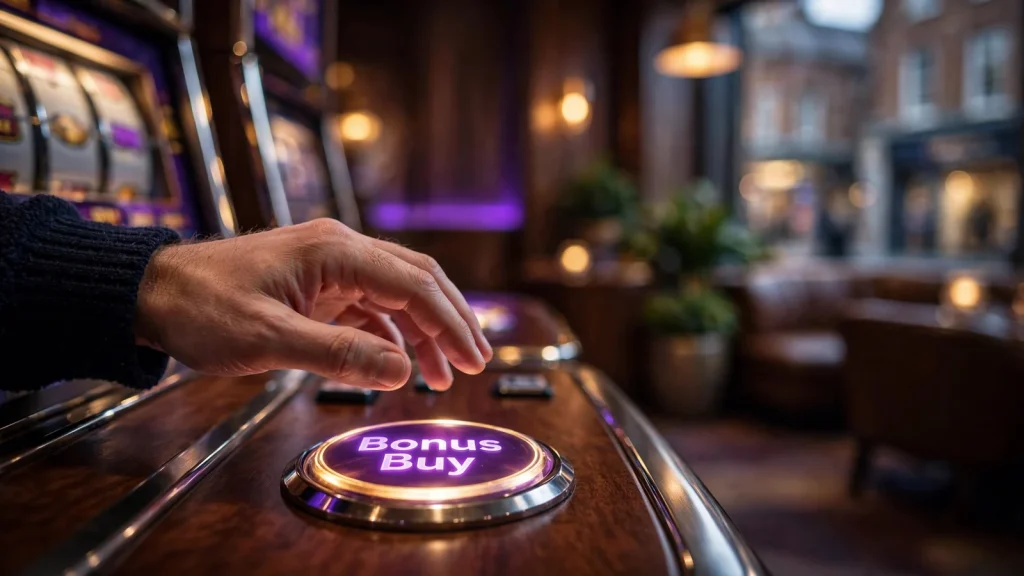
Learn how bonus buys affect entry to a round, why they do not change a slot’s underlying maths, and how demo play can help assess a game.
What a Bonus Buy Changes—and What It Doesn’t
A bonus buy is a slot feature that lets you pay to enter a bonus round instead of waiting for the game to trigger it during ordinary play. The appeal is obvious: you skip the suspense of hoping the feature appears and go straight to the part with extra mechanics, such as a different screen or a run of bonus spins.
That is the shortcut. It is not a shortcut to profit.
I used to treat a bonus round as if it were a separate chance with better odds. It feels different from the base game, and the extra animations can make the purchase seem like a deliberate move rather than another wager. But buying entry changes how you reach the feature, not the basic maths of the game. A bonus round can pay a large amount, a small amount, or nothing useful against what you spent to enter it.
The key idea is mathematical expectation: the average result implied by a game’s probabilities and payouts over a long run of play. A slot with a positive house edge has a negative expectation for the player over enough sessions. It does not matter whether the losses arrive in a slow drip through ordinary spins or in sharper swings around bonus rounds. The timing and shape can feel very different; the underlying disadvantage remains.
That distinction matters when you see language like “instant bonus” or “buy the bonus”. “Instant” means you reach the feature without waiting for its normal trigger. It does not mean a guaranteed win, a better return, or a way to remove the house edge. You are paying for access to a particular part of the game, not purchasing a result.
The bonus-buy price can also make the experience feel disconnected from the regular spin. Instead of staking through the base game, you commit a larger amount at once to reach the feature. That can make a win look dramatic, but the amount returned still has to be judged against the cost of entry. A flashy payout is not automatically a profitable one.
So, what is a bonus-buy slot? It is a slot that offers this paid route into its bonus round. The feature may change the pace and the experience, but it does not turn the game into a favourable bet. I had to stop confusing “more action” with “better value”. Not the same thing.
Fast payout online casinos in the UK: what to check
If you are deciding whether to buy a bonus, keep the price and the possible outcome in the same frame. Don’t judge it by the feature’s spectacle or by one memorable result. The purchase changes when you encounter the bonus; it does not promise what happens once you get there.
Bonus Buy Slots in Britain: The Stake Limit Still Applies
A bonus buy can make a slot’s feature available without waiting for it to trigger during ordinary play. It does not, however, give you a separate pot of stake money or an exemption from the rules for online slots. The age-based limits are the important part to understand before you consider the feature.
An affiliate gambling review reports that, in Great Britain, the maximum stake for an online slot game cycle is £2 for players aged 18 to 24 and £5 for those aged 25 or over. Those are limits on the total stake in a cycle, not a special allowance for a bonus round. A feature purchase does not turn a slot into a different kind of game for this purpose.
That distinction matters because the price of a bonus buy can look separate from the normal spin stake in the game’s interface. The label may make it feel like an optional add-on, but you should not assume that it sits outside the slot’s stake rules. For a player, the practical check is whether the amount committed to that game cycle stays within the limit that applies to their age. The feature changes how play reaches a bonus; it does not mean you can stake more than the permitted amount.
The age split can also make the same game appear different to two players. Someone aged 24 and someone aged 25 do not have the same maximum online slot stake in Great Britain. If you are in the younger age band, a bonus buy that is offered at a price above your applicable limit should not be treated as a loophole. The cap still matters, even if the game presents the purchase as a shortcut to its feature rather than a conventional spin.
I have found it easy to focus on the bright button and miss the less exciting detail: what the game is asking me to stake for that cycle. With a bonus buy, that quick glance is especially worth slowing down. Read the displayed cost and the game information, and keep the age-based cap in mind before confirming anything. A feature can be optional; the limit is not.
Video Slots in the UK: How the Games Work
There is a wider difference between a slot’s advertised mechanics and the rules governing play in Britain. The cap concerns online slot play, not every kind of gambling. But changing from a standard spin to a bonus-buy option does not change the game into something outside the slot category. Nor does the name of a feature decide which stake limit applies. What matters here is that you are playing an online slot and the amount staked in its game cycle.
That is why phrases such as “buy the bonus” can be misleading if they make the feature sound like a separate product. You are still interacting with the slot. The bonus round may have its own sequence of reels, prizes or decisions, but it belongs to the slot experience that led into it. I would not read a purchase button as permission to ignore the limit shown by the rules for your age group.
The limit is also not a target. Being allowed to stake up to the relevant maximum does not mean you need to stake that much, and it does not make a bonus buy better value. If the feature’s cost would take you beyond the amount that applies to you, leave it alone rather than looking for a workaround. If the display is unclear about what will be staked, pause instead of guessing.
For UK readers, it is worth keeping the wording precise: the age-based figures cited here refer to Great Britain’s online slot limits. They are not a promise that every game will offer a bonus buy at a permitted price, or that every interface will explain the feature in the same way. The cap sets a boundary on the stake; it says nothing about whether a particular bonus is worthwhile.
A bonus buy may shorten the route to a feature. It does not shorten the rules. Be clear about your age band, the stake attached to the game cycle and what the game is asking you to commit before you press on. Slow down first.
3-Reel Slots in the UK: What Sets Them Apart
Our top casino picks for the UK
- ChanzeBonus: Slots Welcome Bonus #1 200% up to €500 · Payout speed: 1-3 business days
- AmunbetBonus: Join now and get 450% up to 2,700 GBP + 450 FS · Payout speed: 1-3 business days
- x3betBonus: Welcome Pack 100% Up to £1.000 + 200 Free Spins · Payout speed: 1-3 business days
- Revery PlayBonus: 100% up to€1,000+ 100 FS · Payout speed: 1-3 business days
- NightLuckBonus: Welcome Pack + 805% Up To 6400€ + 280 FS · Payout speed: 1-3 business days
- BritsinoBonus: Welcome Package – Get your £2,200 + 2,000 FS · Payout speed: 1-3 business days
Choosing a Casino for Bonus-Buy Play
When I’m considering a casino for bonus-buy play, I start with the operator, not the slot menu. A game can look appealing and still be a poor reason to trust the site hosting it. Before creating an account, I check whether the business is authorised to offer real-money gambling to customers in Great Britain.
The UK Gambling Commission regulates commercial gambling in Great Britain, including remote gambling, and it is the sole regulator for commercial gambling there. An operator selling into the British market needs the relevant Commission licence even if its equipment is based elsewhere. That’s the bit promotional pages can glide past.
Check the operator, not just its logo
A UKGC badge on a page is not the same as confirming the operator’s status. I look up the business on the Commission’s public register and check that the licence is current and covers the gambling being offered. The register can also help distinguish the legal entity behind a casino from a brand name shown on its homepage.
That distinction matters. A site may use one name in its advertising and another in its terms or account information. If I can’t work out which business would hold my account, handle a complaint or be responsible for the service, I don’t treat a reassuring logo as an answer. Check the licence number against the public register before depositing.
A licensed operator is accountable within the British regulatory system. That does not mean every session will go well or that a casino can remove the risk of losing. It means there is a regulator and a framework governing the operator’s conduct. Those are different things. No magic shield.
Look for usable safeguards
I also check what the account controls actually let me do. UK-licensed casinos must offer responsible-gambling tools, including self-exclusion, and remote operators must prompt new customers to set a financial limit before their first deposit. They must also provide accessible account-level limit controls.
I’d rather know where those controls are before I need them. Can I find the limit settings from the account area? Is self-exclusion clearly explained? Do the terms tell me how to contact support if I can’t use a tool or need help with my account? A responsible-gambling page that exists but is hard to locate is less useful in practice.
Age checks matter too. Operators must verify a customer’s age before allowing them to deposit funds. Online gambling is legal for adults aged eighteen and over when the operator holds a UK Gambling Commission licence. If a site appears casual about age or identity checks, that’s a warning sign, not a shortcut.
Best RTP Casino Slots in the UK: What RTP Means
Payment rules are another useful test of whether an operator is serving the British market properly. UK-licensed casinos cannot accept credit cards for gambling, including credit-card funding routed through a money service business. They also cannot accept wallet payments where the wallet allows credit-card funds to be used for gambling. If the cashier seems to offer a way around those restrictions, I would stop and check what business is actually taking the payment.
Know what happens when there’s a dispute
Before signing up, I scan the complaints information as well as the welcome pages. UKGC licensees must provide an internal complaints process and access to an approved Alternative Dispute Resolution service. That gives customers a route to raise an issue beyond a chat window, though it is still sensible to keep a clear record of relevant messages and account details.
I look for the operator’s complaint steps, how to contact it, and what happens if the complaint remains unresolved. If those details are buried or unclear, I’d want an explanation before putting money into the account. The same applies to account terms: they should identify the operator and explain how customers can reach it.
None of this tells you which casino has the best games, and I wouldn’t use a claimed bonus-buy selection as a substitute for checking the business. Search phrases like “casino bonus buy UK” can lead to sites with confident-sounding claims, but the practical question is simpler: is the operator licensed for the British market, and can you verify that independently?
I’ve learned not to confuse a polished front page with protection. Check the licence, the limits, the payment rules and the complaints route before depositing. Then decide whether the operator meets your standards. A game feature is optional; knowing who is responsible for the account isn’t.
Trying Bonus-Buy Slots in Free Demo Mode
A free demo can let you try a bonus-buy feature without putting your own money into the game. The balance shown on screen is made up, though, and any wins are only part of that demonstration. There is no cash-out and no real payout. That distinction sounds obvious until a big win flashes up and your brain starts treating it like money. Mine has done exactly that.
High-RTP Slots in the UK: How to Compare Returns
The useful part is getting a feel for the feature itself. You can see how the slot presents the bonus round, what sort of animations or choices appear, and how the game handles the transition from the base game into the feature. If a bonus buy is available in demo mode, you can also get a sense of how it changes the pace of a session: rather than waiting for a bonus to arrive through regular play, you enter that part of the game directly.
That can make a free trial a decent way to understand the rules on screen. I like being able to pause and work out what a prompt means without feeling that every second is costing me. You can notice whether a feature includes extra selections or stages, and whether the game clearly explains what is happening. If the instructions are confusing in demo mode, they are unlikely to become clearer just because real money is involved.
Still, a demo is not the same experience as playing for money. The credits are not yours, and the result cannot be withdrawn or spent. A free bonus-buy session may also feel less tense because there is nothing real at risk. That changes how you react: it is easy to click through, try something again, or shrug off a poor result when the balance is fictional. Useful for learning the layout. Not a substitute for the real thing.
There is another limit: the demo only tells you what happens in the version you are playing on screen. It does not establish what a real-money session will feel like for you, or make a particular outcome more likely. I used to treat a cheerful run in a free game as a kind of preview. It wasn’t. It was just a run in a game using pretend credits.
So, if you want to play bonus-buy slots for free in the UK, think of the demo as a hands-on introduction, not a way to earn or test a reliable strategy. Use it to learn where the feature appears and how its screens work. Keep the mental label on: play money, no payout.
That label matters most when a demo win looks convincing. The game may display a balance or celebrate a result, but those visuals do not turn the credits into real funds. A free online slot can be entertaining and informative; it cannot pay you. I find that keeping those two ideas separate makes the trial more useful and less likely to blur into a promise the game never made.
Online Slot Payout Percentages: What RTP Means
Which Slot Machines Let You Buy a Bonus?
There is no reliable shortcut from a slot’s name or artwork. A dramatic bonus symbol, a row of reels that looks familiar, or a game described as “feature-rich” does not tell you whether you can pay to enter its bonus round. I used to assume the feature would be obvious. Sometimes it isn’t.
Start with the game’s own information panel. Look for a section describing features, bonus rounds or special options, and check whether it explicitly mentions a bonus buy. The paytable may explain how a bonus can be triggered during ordinary play, but that alone does not confirm that the game lets you purchase entry. Those are different things. Read the wording rather than treating any mention of a bonus as proof.
The game screen can offer another clue. Some slots display a button or menu item for a purchasable feature; others do not. If you cannot find a clear reference in the game’s information or interface, don’t assume the option is hidden somewhere. A missing button may mean the game has no such feature, or that the version available to you does not offer it.
That last distinction matters. A slot may be presented differently across operators, and feature availability can depend on the version being supplied. A catalogue description or promotional tile is a starting point, not confirmation. Open the specific game and check its own rules. If the details remain unclear, the operator’s game information or customer support can clarify what is available.
Reel count is no guide either. A 5 reel slot game can apply a bet across all five reels, but that describes how a bet relates to the reels, not whether a bonus can be bought. I once treated a familiar layout as a clue. It wasn’t one.
Be careful with broad labels such as “bonus slot” or “bonus feature”. They may describe a round that appears after a winning combination, a feature triggered by symbols, or a purchasable entry. Unless the game explicitly says that bonus entry can be bought, the label does not settle it.
If you are comparing machines, make a short check of the exact game’s rules and on-screen options rather than relying on a list that groups titles together. Bonus-buy availability is a feature of the particular game version, not a promise that follows from its theme, provider, or appearance. That small check saves guesswork.
Bonus-Buy Slots at Casinos Not on GamStop
The phrase “not on GamStop” can sound like a simple filter when you are looking for bonus-buy play. It is not a safety rating, though, and it does not tell you whether a casino is authorised to serve people in Britain. I’ve learned to separate those questions before I get drawn in by a slot feature or a polished-looking site.
GamStop is a self-exclusion scheme. A casino being outside it does not, by itself, confirm that the operator holds a UK Gambling Commission licence. The Commission regulates gambling in the UK, including online casinos, and issues operating licences to businesses. For real-money gambling offered to customers in Great Britain, the operator must hold the relevant UKGC licence. A site based overseas is not exempt from that requirement simply because its company or equipment is elsewhere.
That distinction matters. Offshore casinos without a UKGC licence sit outside the UK regulatory system, so you should not assume that protections available through a licensed operator apply there. Before depositing, check the operator’s licence details against the Gambling Commission’s public register. A logo or a claim on the casino’s own pages is not the same as a verified licence.
Look beyond the licence badge, too. UK-licensed operators must provide account tools such as financial limits and self-exclusion, and they must have an internal complaints process with access to an approved Alternative Dispute Resolution service. Those are practical routes if something goes wrong, not decorative policy text. I used to treat the terms page as something to skim after signing up. Backwards move.
A casino outside GamStop may appeal to someone seeking a different account experience, but that does not make it an appropriate workaround for a person who has self-excluded because gambling is causing harm. If you have chosen to block access, trying to find another route can undermine that decision. GamCare and BeGambleAware provide gambling support; contacting a support service is a more useful next step than chasing a site that avoids the scheme.
The same caution applies if you see a bonus-buy casino demo advertised alongside a real-money offer. A demo does not establish that the operator is licensed, and a casino’s presentation cannot substitute for checking its status. Keep the questions separate: whether a particular game has a feature, whether the operator is authorised for the British market, and whether playing is right for you at all.
If a site’s licensing or safeguards are unclear, I would not treat “not on GamStop” as a selling point. It tells you what scheme the casino is outside; it tells you nothing reassuring about the operator.
Bonus-Buy Games: What to Look For
The bonus-buy label tells you that a slot offers paid entry to a feature; it doesn’t tell you what that feature actually does. I’ve learned to look past the button and read the mechanics around it. Two games can both sell bonus access and still feel very different once the feature begins.
Some bonuses centre on free spins, where the reels keep turning without a separate stake for each spin. Others build around multipliers: a win is increased, or a multiplier grows as the feature continues. Check whether the game describes a fixed multiplier or one that can change during the round. The detail matters more than a dramatic animation.
You may also see bonus rounds that collect symbols or wins before applying a multiplier. In that setup, the final result depends on what is gathered during the feature, not just on the moment you enter it. I prefer knowing what the feature is counting before paying to see it play out. Less mystery, fewer surprises.
The main-game layout can offer clues too, though it doesn’t tell the whole story. A low-volatility slot may have five reels, at least twenty-five paylines, fixed jackpot amounts rather than a progressive prize pool, and a bonus round that multiplies accumulated wins. Those are possible design traits, not a promise that every game with those features behaves alike.
Pay attention to how the feature connects to the base game. Does it use symbols you have already been watching for? Does it switch to a different reel layout? Are wins multiplied individually, or is a multiplier applied to a collected total? These are useful distinctions when comparing mechanics, even when the games share familiar labels.
I also check the game’s own rules for what can end a feature and how its outcome is calculated. The rules are more useful than artwork, which can make a modest mechanic look like a life-changing event. “Huge” is a marketing word; the actual feature description is what you can assess.
There isn’t a dependable catalogue that makes every bonus-buy slot interchangeable. Treat each game as its own set of rules: reels, paylines, prize structure and bonus logic. That gives you something concrete to compare without assuming that a new-looking design, or a familiar feature name, means a better result. Fancy graphics don’t change the maths.
How to Use a Slot’s Bonus-Buy Option
Once you’re in a slot that offers a bonus buy, pause before pressing anything. I’ve made the mistake of treating the button like a harmless shortcut, then noticing too late that the purchase price was much larger than the ordinary spin I’d been making. The feature skips the usual wait for a bonus trigger; it doesn’t make the round a better deal.
Read the on-screen price and check what it buys. Some games may offer more than one bonus option, so don’t assume every button starts the same feature. Look at the game’s information panel if the wording is unclear, and make sure you understand whether the amount shown is the full cost of entering the round. If it isn’t clear, I leave it alone.
Then consider the cost against your planned spend, not against a possible win. A bonus round can end without returning the purchase price, and a good result on an earlier attempt says nothing about the next one. I now decide what I’m willing to spend before playing, rather than letting an eye-catching feature make that decision for me. No chasing it.
There is also a legal stake ceiling to keep in view. A specialist review describes the per-game-cycle maximum in Great Britain as £5 for players aged 25 or over and £2 for those aged 18 to 24. The relevant limit depends on your age, and the amount staked in the cycle must stay within it. Don’t assume that a bonus-buy button sits outside the slot’s ordinary stake rules; check that the purchase fits before confirming.
If the cost feels too large, or you’re unsure what the option does, carry on with ordinary spins or close the game. You don’t have to use every feature a slot puts in front of you. I’ve found that walking away from a tempting button is a lot easier than trying to win back money after clicking it.
Once you choose to proceed, use the game’s own controls and read the confirmation prompt before accepting. Treat that prompt as a final check of the cost and selected feature, not as a suggestion that the purchase is worthwhile. Set your limit first. Then stick to it.
Free Demo Play: A Useful Test, Not a Forecast
A free demo can show you how a bonus-buy feature behaves on screen, but it cannot tell you what will happen when you play for real money. The credits are fake, and any win shown in the demo has no cash value. There are no real payouts to collect.
I find demos useful for getting a feel for the sequence: what the bonus round looks like, how its choices are presented, and whether I understand what I’m selecting. That’s a practical test of the game’s layout. It is not a rehearsal that promises the same result later.
It’s easy to remember a demo session that ended with a big-looking win and treat it as evidence that the feature is generous. I’ve made that mistake. The result was just one run with pretend credits; it didn’t establish what a real-money session would return. A losing demo run is no better as a forecast. Neither result predicts your next attempt.
That distinction matters with free play demo slots that include a bonus buy. The feature may be available in the demo, but using it there does not make the experience financially equivalent to buying a bonus with real money. Fake credits don’t carry the pressure of a real stake, and a displayed balance in demo mode isn’t money you can withdraw.
Use the demo to learn, not to build confidence in a payout. If you’re unsure what a button does or how the bonus round unfolds, trying it with fake credits can help you understand the interface. If you’re using the results to decide that a real-money purchase is likely to pay, the demo has stopped being a useful test.
Keep the takeaway modest: you’ve seen how the feature works in that playthrough. You haven’t measured what it will return, or learned what your next real-money session will do. That’s the line I try to hold, especially after a demo hands out a result that looks tempting. Fake money. No forecast.
What the Bonus-Buy Feature Means for Volatility
Volatility is about the shape of a slot’s results, not whether it is “good” or “bad”. A low-volatility game tends to return value through a stream of smaller wins. A high-volatility one can go longer without a payout, with larger wins arriving less often. Neither pattern promises that your session will end ahead.
I used to treat a run of little wins as proof that a slot was being kind. It feels reassuring: the balance moves, something flashes, and you get another go. But frequent payouts are not the same as a strong overall return. A low-volatility game can still gradually take more than it gives back.
Across many low-volatility titles, winning combinations tend to appear every three to six spins on average. That describes a broad pattern, not a schedule for your next session. You could see several close together, or go longer without one. A machine has no memory of what just happened.
A bonus-buy option can make that pattern feel more intense because you pay to enter a feature rather than waiting for it to arrive through ordinary play. But the label alone does not tell you whether the bonus is low or high volatility. The size and frequency of its returns depend on the particular game, and a bonus round can feel very different from its base game.
That distinction matters. If you prefer a steady run of smaller hits, a high-volatility bonus may feel rough even when the game’s ordinary spins seem calm. If you are drawn to the possibility of a larger payout, remember that less frequent wins also mean more stretches with nothing to show for the stake. The excitement is not evidence of better value.
The longer view is the part I once tried to ignore. Any slot with a positive house edge has negative mathematical expectation over enough sessions, whether losses arrive slowly in small pieces or in sharper swings. Volatility changes the route, not that basic direction.
So I now read “frequent wins” as a description of pacing, not a promise about profit. With a bonus-buy feature, ask yourself whether you can tolerate the swings of the feature itself—not just the feel of the regular spins. If a losing run would make you chase the cost back, that is a warning to stop, not a reason to buy another round.
Different rhythm. Same risk.